


Summary
Welcome to this week’s MP Market Review – your go-to source for insights and updates on the Canadian dividend growth companies we track on The List! While we’ve expanded our watchlists to include U.S. companies, The List-USA, our Canadian lineup remains the cornerstone of our coaching approach.
Don’t miss out on exclusive newsletters and premium content that will help you sharpen your investing strategy. Explore it all at magicpants.substack.com.
Your journey to dividend growth mastery starts here – let’s dive in!
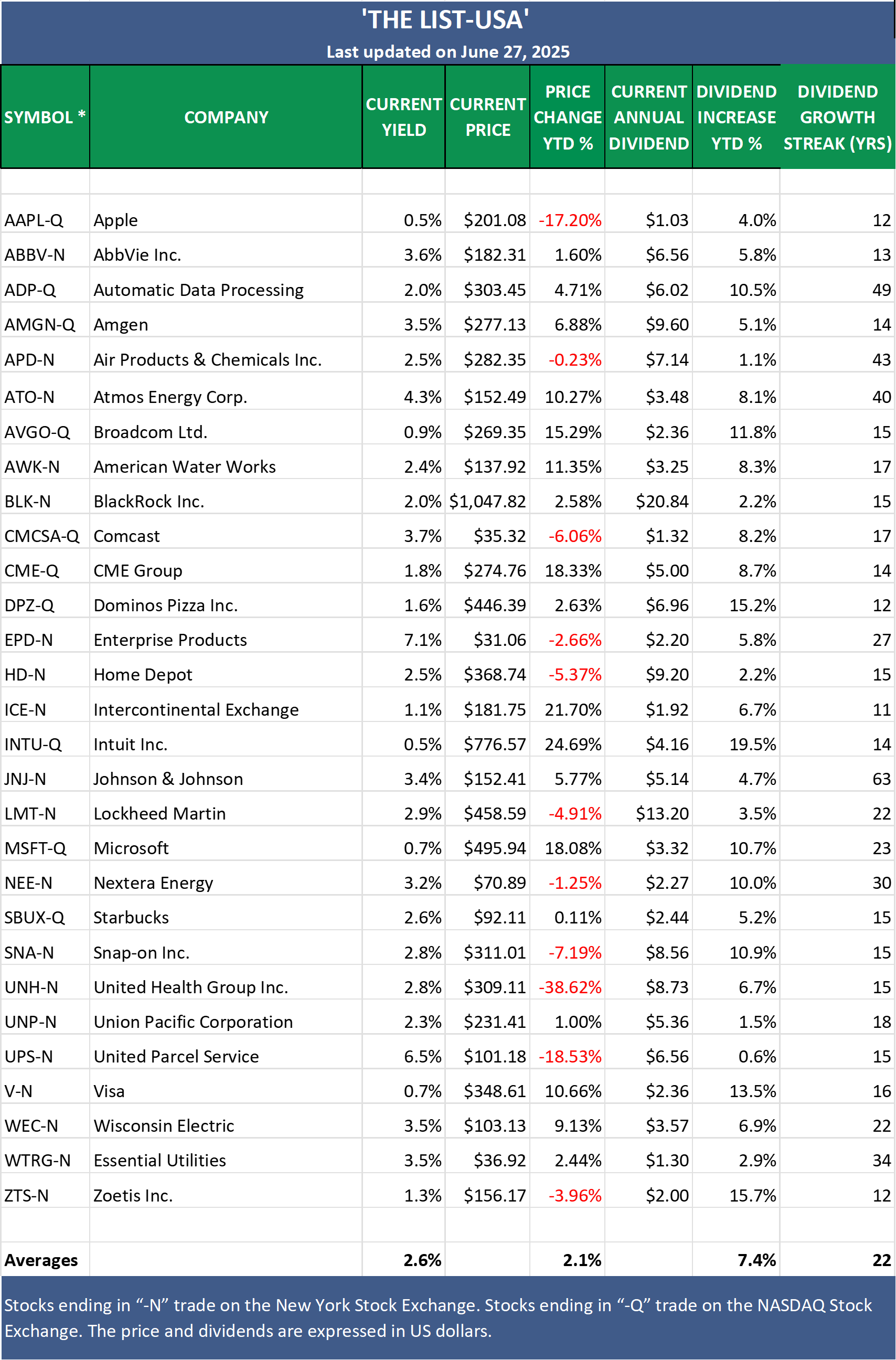
Check out our monthly update on The List-USA below, right after our Canadian version of The List.
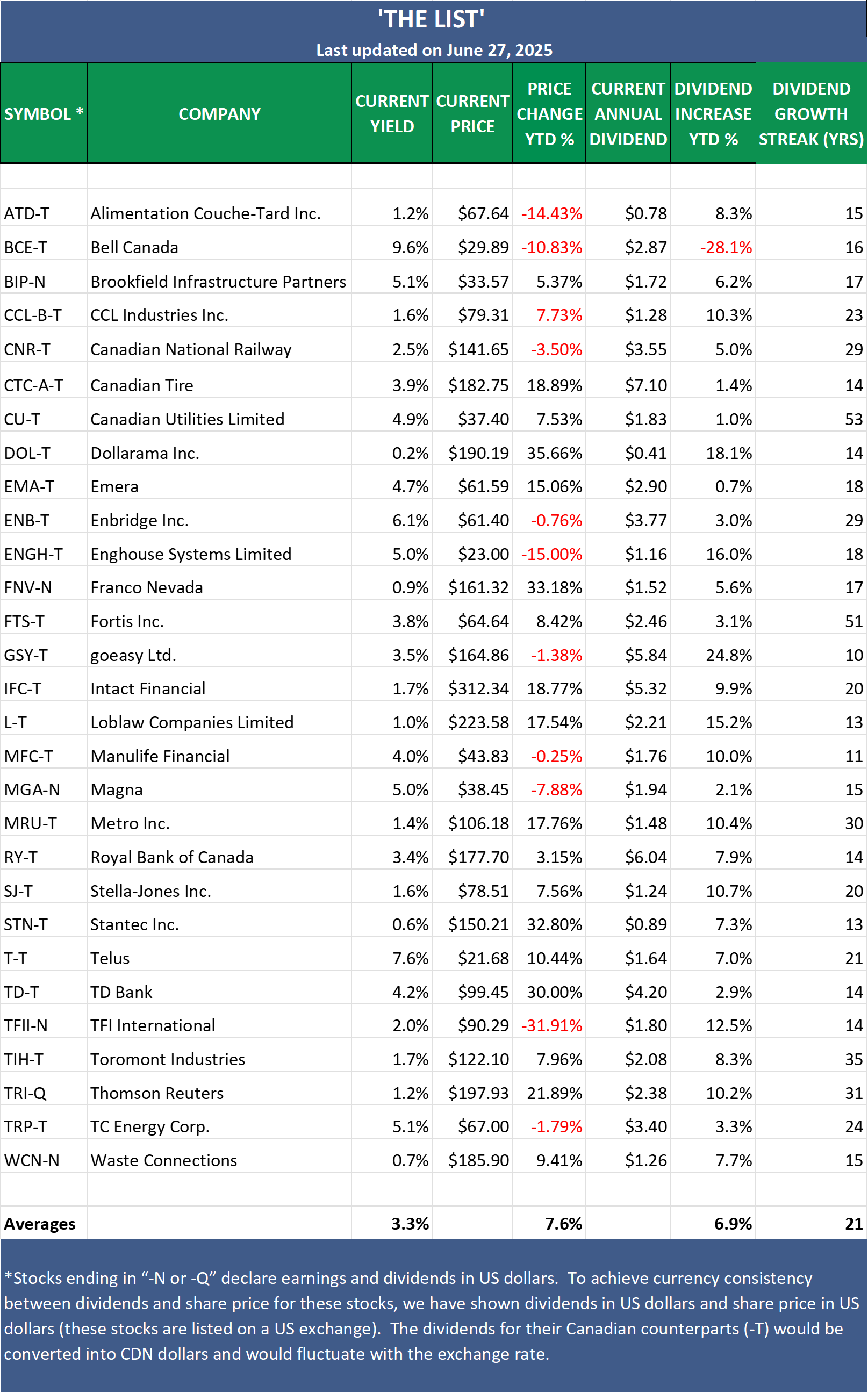
Last week, dividend growth stayed the same with an average return of +6.9% YTD (income).
Last week, the price of The List was up from the previous week with an average return of +7.6% YTD (capital).
Last week, there were no dividend announcements from companies on The List.
Last week, there was one earnings report from a company on The List.
This week, no company on The List will report on earnings.
DGI Clipboard
“How do we protect our principle? With growing yields, over time, from fine companies.”
- Tom Connolly
Are You Measuring the Right Yield? Most Investors Get This Wrong
Intro
Yield on Cost, or as we prefer to define it, Growth Yield, is one of the best ways to measure and estimate dividend growth investing success. We will show you how you can also use this metric to build a powerful DGI portfolio.
First, a couple of definitions:
Dividend Yield is the current annualized dividend divided by the current price of the stock
Growth Yield is the current annualized dividend divided by the original cost basis of the stock
In other words, Dividend Yield is your current yield, and Growth Yield is the yield you are now making, on dividends alone, from your original investment sometime in the past.
Using both a historical and estimated Growth Yield, we have found that you can reliably construct powerful DGI portfolios.
As mentioned before, dividend growth investing is a risk-reduction strategy that leads us to the highest quality companies. The Growth Yield metric is one way to get there.
First, we need to decide on the minimum Growth Yield we would like to achieve after ten years of holding the stock. This is a personal decision based on your own objectives. We like a minimum average Growth Yield of 7% in our Magic Pants Wealth-Builder Portfolios. This confirms we have the right combination of starting yield and dividend growth.
The first thing we do is examine the company’s historical record and its performance over the last decade, keeping our minimum Growth Yield in mind. The historical Growth Yield calculation is an easy one. Start with the current annualized dividend and divide it by the stock price ten years ago. If the Growth Yield is greater than 7% you now have a candidate for further analysis.
Next, we estimate whether this type of dividend growth is likely to continue. Estimating Growth Yield ten years out can be calculated by taking the current (or starting) dividend yield and multiplying it by the average annual forward dividend growth rate to the power of the period in question (5 for the next five years, 10 for the next ten years). We will use a ten-year period for our demonstration.
Forward dividend growth rates can be somewhat more challenging. Some companies make it easier and publish their estimated dividend growth rates in their earnings reports. If company estimates are not available, you can always look at the recent past (3-5 yrs) and estimate a forward growth rate.
Here’s a recent example of how we used both growth yield calculations prior to purchasing Manulife Financial for our Canadian model portfolio, roughly one year ago
The Historical Growth Yield is an actual value based on an investment made ten years ago.
Historical Growth Yield calculation for Manulife Financial (MFC-T)
Formula: Current Dividend (2024) / Price Jan. 1, 2014
$1.60 / $20.73 = 7.7%
The Estimated Forward Growth Yield is a forecasted value over the next ten years based on today's investment.
Estimated Growth Yield calculation for Manulife Financial (MFC-T)
Formula: Current Yield (Jan. 1, 2024) * 5YR average annual dividend growth rate ^ Period (10 years)
4.86% * 10.0% ^ 10 = 12.6%
In this case, Manulife Financial easily meets both our minimum Growth Yields (historical and estimated).
To put this metric in context, if you invested $10,000 in Manulife Financial (MFC-T) in March 2024, based on our estimates, you can anticipate earning approximately $1,260 annually from dividend payments alone after ten years. This projected return significantly surpasses our 7% threshold, highlighting the attractive income potential for investors over the long term.
Purchasing companies at a ‘sensible price’ is still essential in our process, and you should not blindly add positions based on Growth Yield alone. Valuation at the time of purchase will improve your future performance.
Takeaway
Our purchase of Manulife Financial stock has turned out to be a good one, as the stock has increased by 33% since our purchase. As expected, the 10% dividend increase announced earlier this year was right in line with our forward estimate.
Assembling a portfolio with an average Growth Yield of 7% or better (with some yields lower and some higher) is achievable from companies on The List. Conduct your own analysis with all the stocks on The List, establish a ‘sensible price’ to enter a position, determine your position sizes based on quality ratings, and start building a powerful DGI portfolio.
Join as a paying subscriber to gain full access to this post and exclusive, subscriber-only content. Plus, get real-time DGI alerts from our model signaling service whenever we make trades in our portfolios. We do the work; you stay in control. Subscribe today and take your dividend growth investing to the next level!
DGI Scorecard
The List (2025)
The Magic Pants 2025 list includes 29 Canadian dividend growth stocks. Here are the criteria to be considered a candidate on ‘The List’:
Dividend growth streak: 10 years or more.
Market cap: Minimum one billion dollars.
Diversification: Limit of five companies per sector, preferably two per industry.
Cyclicality: Exclude REITs and pure-play energy companies due to high cyclicality.
Based on these criteria, companies are added or removed from ‘The List’ annually on January 1. Prices and dividends are updated weekly.
‘The List’ is not a portfolio but a coaching tool that helps us think about ideas and risk manage our model portfolio. We own some but not all the companies on ‘The List’. In other words, we might want to buy these companies when valuation looks attractive.
Our newsletter provides readers with a comprehensive insight into the implementation and advantages of our dividend growth investing strategy. This evidence-based, unbiased approach empowers DIY investors to outperform both actively managed dividend funds and passively managed indexes and dividend ETFs over longer-term horizons.
Note: In the last week of every month, I will show the updated watchlist for our American dividend growers, The List-USA. It will be shown after the Canadian watchlist below.
Performance of 'The List'
Last week, dividend growth stayed the same, with an average return of +6.9% YTD (income).
The price of 'The List' was up from the previous week, with an average YTD return of +7.6% (capital).
Even though prices may fluctuate, the dependable growth in our income does not. Stay the course. You will be happy you did.
Last week's best performers on 'The List' were Stella-Jones Inc. (SJ-T), up +4.39%.; Manulife Financial (MFC-T), up +4.04%; and Stantec Inc. (STN-T) up +3.89%.
Alimentation Couche-Tard Inc. (ATD-T) was the worst performer last week, down -3.41%.
The final off-cycle earnings report arrived last week, with Couche-Tard wrapping up the early season. Our full analysis of calendar Q2 will begin in late July, when the majority of companies on The List report their results. In the News section below, you’ll find an insightful article on the long-term advantages of owning stocks over bonds, along with an update on renewed trade discussions between the U.S. and Canada.
