


Summary
This is not a stock-picking newsletter!
It’s a behind-the-scenes look at how a dividend growth portfolio is built, maintained, and improved over time.
Welcome to this week’s MP Market Review.
Before we begin, a quick explanation of the name.
Many years ago, when I first discovered dividend growth investing, I came across a quote that stopped me in my tracks:
“You have a pair of pants. In the left pocket, you have $100. You take $1 out of the left pocket and put it in the right pocket. You now have $101. There is no diminution of dollars in your left pocket. That is one magic pair of pants.”
That is dividend growth investing in its simplest form.
When a quality company pays a dividend, cash moves from the company’s pocket to yours, yet your ownership stake remains intact. As earnings grow, dividends tend to grow. As dividends grow, share prices often follow. Reinvest those dividends into additional shares, and the cycle accelerates: more shares generate more dividends, which buy even more shares.
That’s the magic.
It’s why we call this newsletter Magic Pants Dividend Growth Investing.
Every week, we track the companies on The List, our curated watchlist of Canadian dividend growth businesses selected for their ability to produce rising income over time. While we also publish a U.S. edition each month, Canada remains our primary hunting ground.
Our objective is straightforward:
Grow dividend income by 7-10%+ annually while achieving long-term capital appreciation that matches or exceeds the TSX Composite in Canada and the S&P 500 in the United States.
What follows is not theory.
It is the real-world application of a dividend growth strategy using real money, real positions, and real results.
Markets create an endless stream of noise. We ignore most of it.
Instead, we focus on a handful of metrics that tell us whether our process is working. No predictions. No forecasts. No crystal ball.
Just results.
The magic is in the dividend. Dividends lead. Prices follow.
This Week’s Scorecard
MP Wealth-Builder Model Portfolio (Canada)
Annualized Total Return: +17.11% since inception
Total Return (includes dividends): +17.95 % year-to-date
Current Yield: 3.2%
The List (Canada)
Dividend Income Growth: +6.6% year-to-date
Capital Appreciation: +8.1% year-to-date
Dividend Announcements Last Week: None
Earnings Reports Last Week: Six
Earnings Reports This Week: Five
DGI Clipboard
“The best protection against a dividend cut begins before you buy the stock.”
— Magic Pants Dividend Growth Investing
Dividend Cuts Happen. Your Process Matters More.
When the Dividend Gets Cut
A dividend cut changes the investment thesis. Here’s how we deal with it.
In light of TELUS’s recent dividend cut, we thought this would be a timely opportunity to revisit how we handle dividend cuts within our dividend growth strategy.
Dividend growth investing is built around a simple idea: own high-quality businesses that generate growing cash flow and share that growth with shareholders through rising dividends.
But even quality companies can stumble.
When a dividend is cut, suspended, or frozen, we don’t panic. We also don’t ignore it.
We go back to the investment thesis.
The Warning Signs Often Come First
At Magic Pants, we believe dividends lead and prices follow.
A steadily growing dividend is usually evidence of a healthy business: rising earnings, strong cash flow, prudent capital allocation, and management confidence.
But there are often warning signs before a dividend cut occurs.
One of the most obvious is an excessively high dividend yield.
TELUS was a good example. As its share price declined, its dividend yield climbed to increasingly attractive levels. But a rising yield isn’t always an opportunity. Sometimes the market is telling you something is wrong.
When a company’s yield becomes unusually high relative to its history and peers, we dig deeper.
Is the stock genuinely undervalued, or is the market anticipating weaker cash flow, excessive debt, or an unsustainable dividend?
We never chase yield. An excessively high yield is often a warning, not an opportunity.
A Dividend Cut Changes the Conversation
When a company cuts its dividend, our first question isn’t:
“Will the stock price recover?”
It’s:
“Is this still the quality dividend growth company we originally purchased?”
We don’t necessarily sell the morning a dividend is cut. We first determine why it happened.
Is management temporarily conserving capital to strengthen the balance sheet? Or have the economics of the business fundamentally deteriorated?
If earnings power remains intact and there is a credible path toward renewed dividend growth, patience may be warranted.
But if the cut reflects excessive debt, deteriorating fundamentals, poor capital allocation, or a permanently impaired business model, the investment thesis may be broken.
And when the thesis is broken, we’re prepared to move on.
Quality First. Always.
This is precisely why our process begins with quality.
We favour companies with strong balance sheets, sustainable payout ratios, durable businesses, and long histories of growing their dividends.
Our objective isn’t to eliminate dividend cuts. That’s impossible.
Our objective is to make them rare.
Diversification and disciplined position sizing also ensure that one dividend cut doesn’t materially damage our overall income stream.
The Portfolio Matters More Than the Stock
We aren’t emotionally attached to individual companies.
Our goal is to build a portfolio capable of growing its dividend income by approximately 7–10% annually over the long term.
Sometimes that means holding through temporary adversity. Sometimes it means admitting the thesis has changed and reallocating our capital to a better opportunity.
The key is having a process before the bad news arrives.
A dividend cut isn’t automatically a sell signal. It’s a signal to reassess.
Quality first. Valuation second. Monitor always.
Because we’re not simply collecting stocks. We’re building a growing income machine.
Takeaway
Dividend cuts are an unfortunate reality of dividend growth investing, but they don’t have to derail a well-built dividend growth portfolio. Focus on quality, watch for warning signs such as an unusually high yield, and reassess the investment thesis when circumstances change. Our goal isn’t to avoid every mistake; it’s to ensure that no single mistake compromises our long-term objective: a reliable and growing stream of dividend income.
Looking for a helping hand in the market? Members of Magic Pants Dividend Growth Investing get exclusive ideas and guidance to navigate any climate.
The Magic Pants model portfolios (Canadian and American) are real-money, dividend-growth portfolios funded with actual capital and executed in live accounts. Every position shown is owned, sized, and tracked in real time using our disciplined DGI process.
Become a PAID subscriber, and I’ll show you exactly how I do it. In addition, gain full access to this post and exclusive, subscriber-only content. We do the work; you stay in control!
DGI Scorecard
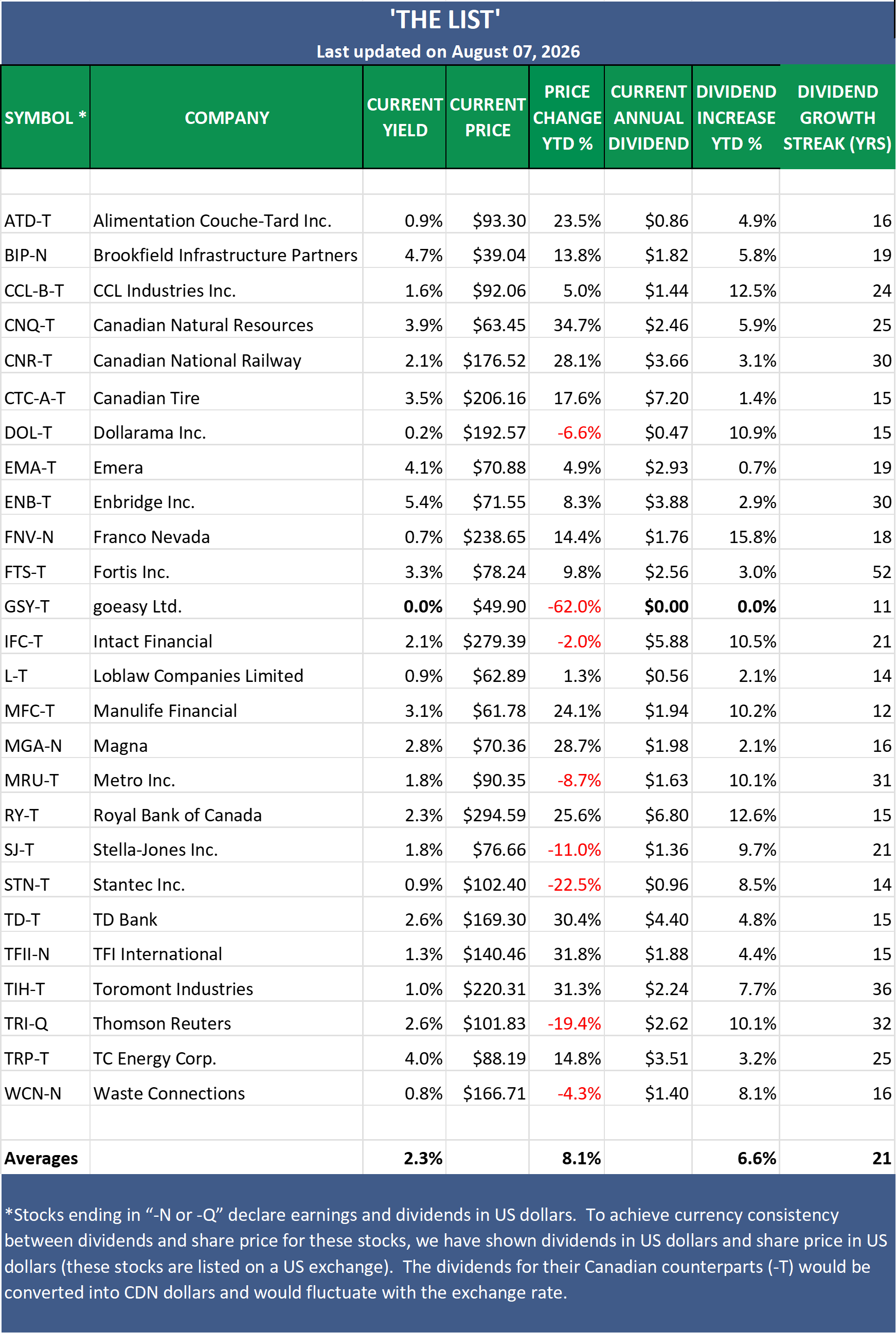
The Magic Pants 2026 list (The List) includes 26 Canadian dividend growth stocks, and our new American watchlist (The List-USA) contains 28 companies. Here are the criteria to be considered a candidate on our watchlists:
Dividend growth streak: 10 years or more.
Market cap: Minimum one billion dollars.
Diversification: Limit of five companies per sector, preferably two per industry.
Cyclicality: Exclude REITs and pure-play energy companies due to high cyclicality.
Based on these criteria, companies are added or removed from ‘The List’ annually on January 1. Prices and dividends are updated weekly.
‘The List’ is not a portfolio but a coaching tool that helps us think about ideas and risk manage our model portfolio. We own some but not all the companies on ‘The List’. In other words, we might want to buy these companies when valuation looks attractive.
Our newsletter provides readers with a comprehensive insight into the implementation and advantages of our dividend growth investing strategy. This evidence-based, unbiased approach empowers DIY investors to outperform both actively managed dividend funds and passively managed indexes and dividend ETFs over longer-term horizons.
Note: In the last week of every month, I will show the updated watchlist for our American dividend growers, The List-USA. It will be shown after the Canadian watchlist below.
Performance of 'The List'
The dividend growth for The List remained unchanged last week, with an average YTD increase of 6.6% (income).
The price of The List was down slightly last week and now stands at +8.1% YTD (capital).
Top Performers Last Week:
Franco Nevada (FNV-N), up +12.08%.
goeasy Ltd. (GSY-T), up +4.79%.
Toromont Industries (TIH-T), up +4.48%.
Worst Performer Last Week:
TC Energy Corp. (TRP-T), down -6.58%.
From breaking news to quarterly earnings reports, we break down the week’s biggest headlines to help you make sense of the market.
