


Summary
This is not a stock-picking newsletter.
It’s a behind-the-scenes look at how a dividend growth portfolio is built, maintained, and improved over time.
Welcome to this week’s MP Market Review. Each week, we track the Canadian dividend growth companies on The List, our curated watchlist of businesses designed to produce rising income. While we also publish a U.S. edition monthly, Canada remains our training ground.
Our objective is simple: grow dividend income by 7–10%+ annually while delivering capital appreciation that matches or exceeds the TSX Composite in Canada and the S&P 500 for our U.S. investors over a full market cycle.
What you’re about to read isn’t theory. It’s the real-time application of a dividend growth strategy using real money, with a clear objective: growing income first and letting capital growth follow.
Markets generate a lot of noise. We ignore most of it.
Instead, we track a small set of metrics that tell us whether our dividend growth strategy is working in real time. No forecasts. No opinions. Just results.
Here they are:
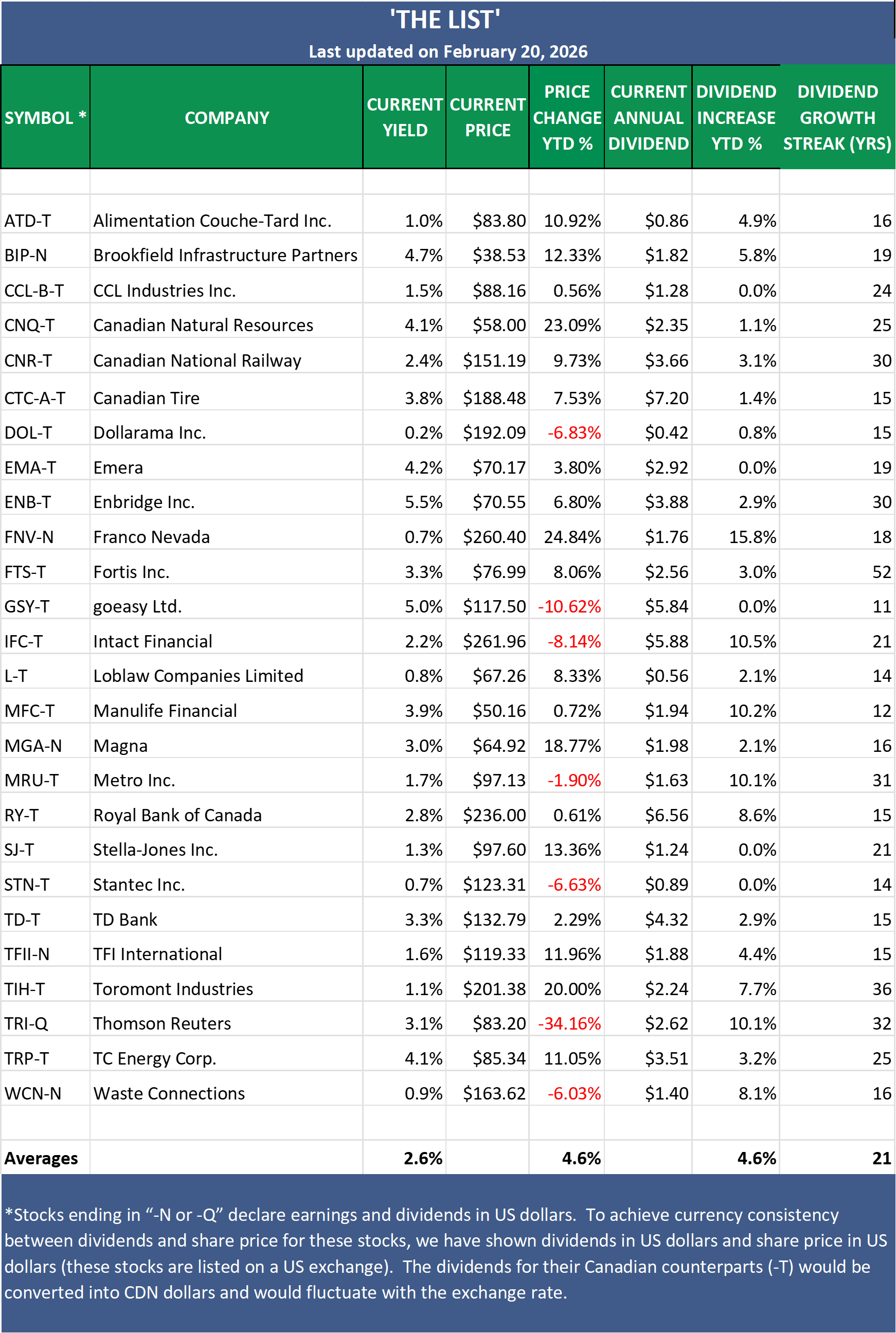
Dividend income from The List: +4.6% year-to-date
Capital value: +4.6% year-to-date
Dividend announcements last week: None
Earnings reports last week: Two
Earnings reports this week: Seven
DGI Clipboard
“How much of your retirement pot can you safely spend every year without dipping into capital?” was the title of a column in Forbes from June 17, 1996 (the year and month I retired from teaching business).
My answer: all of it and more as our pot keeps growing.”
— Tom Connolly, legendary Canadian dividend growth investor
Dividend Investing vs. Dividend Growth Investing
Intro
Same word. Completely different outcomes.
Investors often use the terms dividend investing and dividend growth investing as if they mean the same thing. They don’t.
Both involve owning companies that pay dividends. But the strategy, the mindset, and most importantly, the long-term results are very different.
Understanding this distinction is one of the biggest turning points for new income investors.
Dividend Investing: Income Today
Traditional dividend investing focuses on current yield.
The goal is simple: generate the highest possible income right now.
Investors following this approach typically buy:
High-yield stocks
Utilities and telecoms with slow growth
REITs and income vehicles
Mature or stagnant businesses
The portfolio often looks attractive at first glance. A 6%–8% yield feels powerful. Cash flow starts immediately.
But there is a trade-off.
High current yield usually means low growth. Sometimes no growth at all.
Over time, inflation erodes purchasing power, dividends stagnate, and share prices often go nowhere. In weaker businesses, both income and capital can eventually decline.
Dividend investing gives you income today.
But it rarely builds wealth tomorrow.
Dividend Growth Investing: Income That Compounds
Dividend growth investing flips the focus from yield to growth of income.
Instead of asking, “What pays the most now?” the question becomes:
“Which companies will pay far more in the future?”
Dividend growth investors target:
Companies with durable competitive advantages
Consistent earnings growth
Strong balance sheets
Long histories of raising dividends
These businesses often start with moderate yields of 1%–3%. That can feel unimpressive to yield-focused investors.
But the power is in the growth.
If a company increases its dividend by 7%–10% annually, its income roughly doubles every 7–10 years. Over the decades, this creates what we call bondified equities: stocks that eventually yield far more than their original cost, than any fixed-income investment ever could.
The Critical Link: Dividend Growth and Price Appreciation
Here is the part many investors miss.
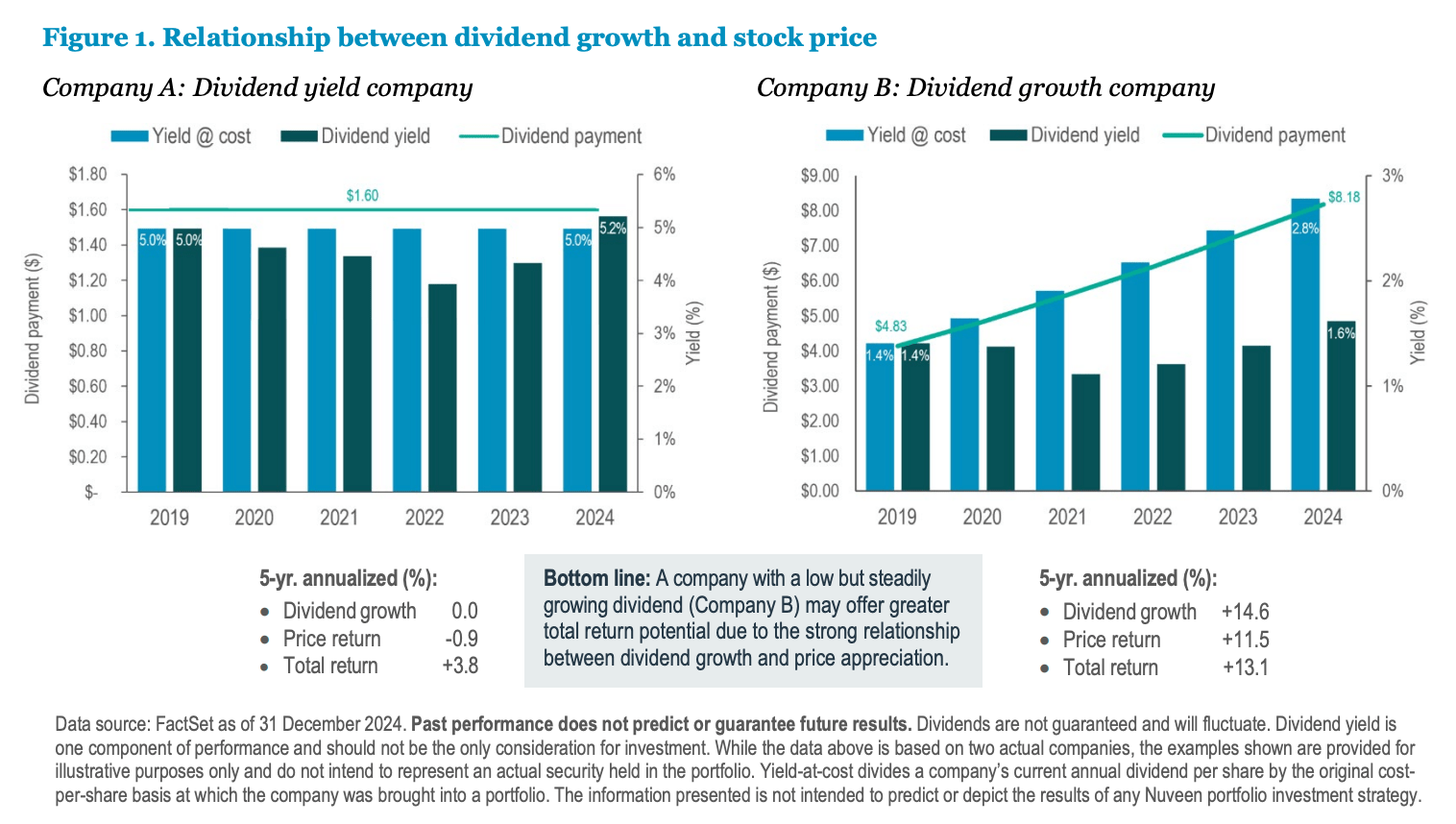
Dividend growth and price appreciation are not separate outcomes.
They are the same economic force expressed in two ways.
Dividends come from earnings.
Rising dividends require rising earnings.
And rising earnings ultimately drive rising share prices.
Over long periods, stock prices follow dividend growth because both reflect the growth of the underlying business.
This is why the best dividend growth companies show a powerful pattern:
Dividend up → Earnings up → Price up
Not every year. Markets fluctuate. Valuations expand and contract.
But over full cycles, dividend growth is one of the most reliable predictors of long-term capital appreciation.
In other words:
Dividend growth investing is not just an income strategy.
It is a total return strategy driven by business growth.
The Outcome Difference
A high-yield dividend portfolio may deliver high income early, but it often plateaus.
A dividend growth portfolio starts slower but compounds relentlessly:
Income rises every year
Purchasing power increases
Capital value grows alongside dividends
Financial flexibility expands over time
Eventually, the income from a dividend growth portfolio often surpasses what high-yield investing could ever sustain.
Takeaway
Dividend investing asks: How much can I earn today?
Dividend growth investing asks: How much can this grow for decades?
One focuses on yield.
The other focuses on compounding.
And in long-term investing, compounding wins.
The Magic Pants model portfolios (Canadian and American) are real-money, dividend-growth portfolios funded with actual capital and executed in live accounts. Every position shown is owned, sized, and tracked in real time using our disciplined DGI process.
Become a paid subscriber, and I’ll show you exactly how I do it. In addition, gain full access to this post and exclusive, subscriber-only content. We do the work; you stay in control!
DGI Scorecard
The Magic Pants 2026 list (The List) includes 26 Canadian dividend growth stocks, and our new American watchlist (The List-USA) contains 28 companies. Here are the criteria to be considered a candidate on our watchlists:
Dividend growth streak: 10 years or more.
Market cap: Minimum one billion dollars.
Diversification: Limit of five companies per sector, preferably two per industry.
Cyclicality: Exclude REITs and pure-play energy companies due to high cyclicality.
Based on these criteria, companies are added or removed from ‘The List’ annually on January 1. Prices and dividends are updated weekly.
‘The List’ is not a portfolio but a coaching tool that helps us think about ideas and risk manage our model portfolio. We own some but not all the companies on ‘The List’. In other words, we might want to buy these companies when valuation looks attractive.
Our newsletter provides readers with a comprehensive insight into the implementation and advantages of our dividend growth investing strategy. This evidence-based, unbiased approach empowers DIY investors to outperform both actively managed dividend funds and passively managed indexes and dividend ETFs over longer-term horizons.
Note: In the last week of every month, I will show the updated watchlist for our American dividend growers, The List-USA. It will be shown after the Canadian watchlist below.
Performance of 'The List'
The List's dividend growth remained unchanged, with an average YTD increase of +4.6% (income). These are dividends announced late last year and early in 2026.
The price of The List went up last week and now stands at +4.6% YTD (capital).
Top Performers Last Week:
Canadian Tire (CTC-A-T), up +4.97%.
Canadian Natural Resources (CNQ-T), up +4.92%.
Stantec Inc. (STN-T), up +3.97%.
Worst Performer Last Week:
Magna (MGA-N), down -5.54%.
From breaking news to quarterly earnings reports, we break down the week’s biggest headlines to help you make sense of the market.
