

Summary
This is a weekly installment of our MP Market Review series, which provides updates on the financial markets and Canadian dividend growth companies we monitor on 'The List'.
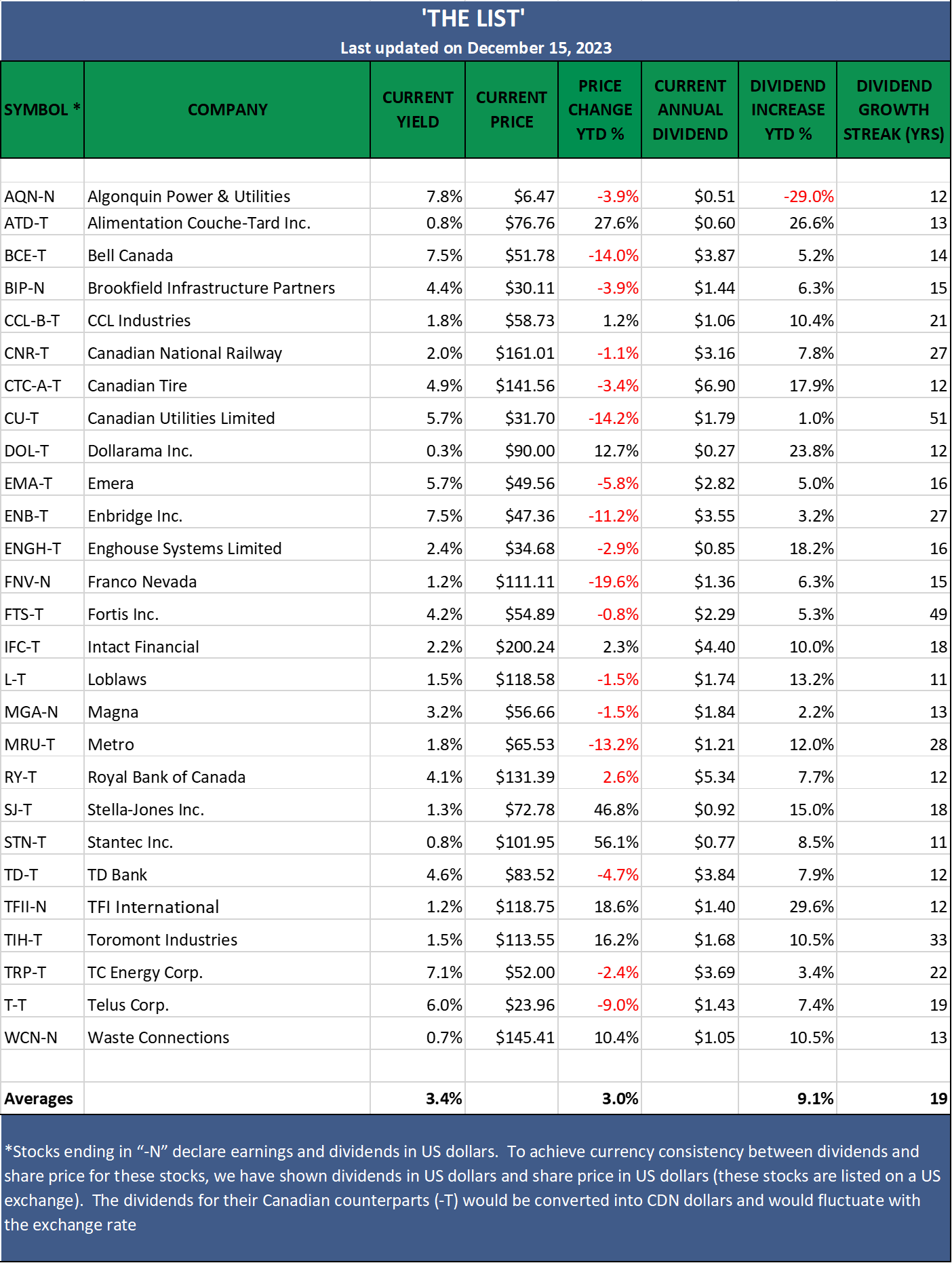
Last week, 'The List' was down with a YTD price return of +3.0% (capital). Dividends have increased by +9.1% YTD, highlighting the growth in the dividend (income).
Last week, there were no dividend announcements from companies on 'The List'.
Last week, there were two earnings reports from companies on 'The List'.
No companies on 'The List' are due to report earnings this week.
The List (2023)
The Magic Pants List includes 27 Canadian dividend growth stocks. Each has raised their dividend annually for the last ten years (or longer) and has a market cap of over a billion dollars. Based on these criteria, companies on ‘The List’ are added or removed annually, on January 1. Prices and dividends are updated weekly.
While 'The List' does not function as a portfolio on its own, it serves as an excellent initial reference for individuals looking to diversify their investments and achieve higher returns in the Canadian stock market. Through our newsletter, readers gain a deeper understanding of how to implement and benefit from our Canadian dividend growth investing strategy.
If you're interested in creating your own dividend growth income portfolio, consider subscribing to our premium service. Subscribers gain access to buy/sell alerts and exclusive content available only to subscribers.
Performance of 'The List'
Last week, 'The List' was down with a YTD price return of +3.0% (capital). Dividends have increased by +9.1% YTD, highlighting the growth in the dividend (income).
The best performers last week on 'The List' were Brookfield Infrastructure Partners (BIP-N), up +6.92%; Algonquin Power & Utilities (AQN-N), up +6.59%; and Waste Connections (WCN-N), up +5.12%.
Dollarama Inc. (DOL-T) was the worst performer last week, down -9.68%.
DGI Clipboard
“The dividend is such an important factor in the success of many stocks, that you could hardly go wrong by making an entire portfolio of companies that have raised their dividends for 10 to 20 years in a row.”
Peter Lynch, Beating the Street p. 49
Spend income not capital
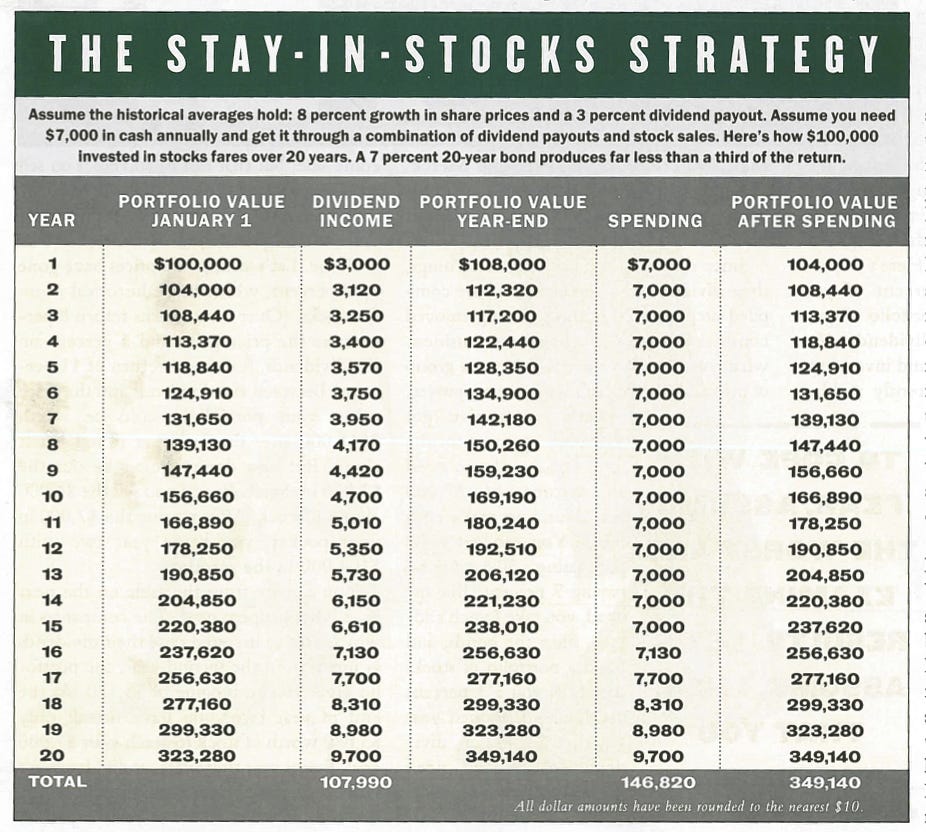
Renowned investor and author Peter Lynch advocated for dividend growth companies, demonstrating in a chart how an investor could annually withdraw 7% in an all-stock portfolio without depleting their funds. The chart highlights the flexibility in retirement funding choices.
For years, financial planners have promoted the ‘4% Rule’ in retirement planning. Switching to a 60/40 mix of bonds and stocks and withdrawing 4% of your hard-earned capital increases the likelihood of outliving your money. For many, this necessitates significant savings during their working years and some sleepless nights in retirement as their income stops growing and they rely more and more on capital performance.
Lynch grasped how dividends drive portfolio performance, and his 'Stay in Stocks' strategy emphasizes this belief. Many financial planners overlook that dividend companies are safer and continue to grow their dividends in retirement, making them more attractive than other stocks or fixed income as a source of growing income.
Nevertheless, a study on withdrawal strategies, that encapsulated seventy-one “rolling” twenty-year periods, concluded that there is still a chance of your portfolio balance falling to zero along the way. Lynch's returns and strategy were based on averages, and as we know, that can sometimes backfire, as evidenced in this study, occurring 15% of the time.
By incorporating one change, the study's author found that he could increase the success of Lynch's 'Stay in Stocks' strategy to 100%. This change, termed the '90% Balance Rule,' stipulates that if, after the income withdrawal is taken at the end of each year, the portfolio balance falls below 90% of the original starting amount, the annual withdrawal is reduced by 50%. In subsequent years, the portfolio balance is monitored for a rise back above 90% of the original starting amount, at which point a 7% income withdrawal can be reinstated.
Applying the '90% Balance Rule' over all 20-year periods of the test sample resulted in 96% of finishing portfolio balances ending above the initial starting level with no portfolio failures. Another notable observation was that a high majority (82%) of the twenty-year periods required none or only one reduction in the withdrawal rate.
The author recommends that investors may want to take additional steps to compensate for a period of lower income derived from reduced withdrawal rates, such as building a 'safe money' bucket or having access to other sources of backup income.
While sustaining oneself solely on dividend income, without capital withdrawals, is achievable for some, for the majority, a DGI plan that combines both income and capital withdrawals while preserving the original capital, and incorporating the '90% Balance Rule,' may be more realistic.
For subscribers of our premium service, we’ll look at how inaccurate market predictions tend to be and what the US Fed’s decision last week meant for us. I’ll also review two earnings reports from ‘The List’ last week. But first, let’s look at what Mr. Powell had to say...
