Introduction
On our journey to mastering dividend growth investing (DGI), we immersed ourselves in extensive research on endowment investing—a time-tested approach to sustainable wealth-building. After all, who better to learn from than those who have preserved and grown wealth for generations?
For much of history, true wealth wasn’t measured by net worth alone, but by the income an investor’s assets could reliably produce. This fundamental principle resonates deeply with us as dividend growth investors.
We often reference Jim Garland’s powerful opening quote from his 2013 paper, Memo to the Darcy Family: To Thine Own Self Be True, as a guiding insight into this philosophy.
“The hero of Jane Austen’s great novel, Pride and Prejudice, was a Mr. Darcy. Mr. Darcy was wealthy — but Austen expressed that fact in a way that today sounds odd. She wrote that Mr. Darcy was worth £10,000 a year. The income from his properties was far more important than the market value of those properties because he lived off that income.”
Mr. Garland illustrates this concept through the story of two farmers:
“Imagine two farms and two farmers. One farmer raises chickens and sells them to grocery stores. We’ll call him a chicken farmer. The other farmer keeps hens in a henhouse and feeds the eggs to his rather large family. The second one is an egg farmer.
The first person, the chicken farmer, is vitally interested in the market value of chickens. The second one, the egg farmer, is vitally interested in the number of eggs that his hens can lay, and in the health of the hens, but he doesn’t care at all about the market value of his hens.
For the chicken farmer, risk means the probability of a decline in the price of chickens. On the other hand, the egg farmer could care less about market values. His risks are foxes, viruses, and other such threats to the well-being of his hens.
Think of stocks as chickens, and dividends as the eggs those stocks provide. Total return investors are chicken farmer investors, because they worry about the market value of their “chickens” – of their stocks. On the other hand, endowment investors are egg farmer investors. All that endowment investors worry about is the current and future quantities of their “eggs” – their dividends.”
Like Garland, we see the clear parallel between endowment investors and egg farmers. But as dividend growth investors, we take it one step further. Instead of settling for any dividend-paying stock, we focus exclusively on dividend growth stocks—companies that consistently increase their payouts year after year. Our experience has shown that businesses with a strong track record of dividend growth tend to deliver capital appreciation at a similar pace. The combination of a rising dividend and a growing share price is a powerful wealth-building engine.
Armed with a strategy that pays us in both up and down markets, we remain patient, waiting for the right opportunities to buy quality dividend growers at sensible prices. After all, in today’s chicken-farming world, the key to building wealth is simple: buy more income at a lower price.
And what better way to demonstrate our approach than by building a dividend growth portfolio from the ground up?
Summary
“A goal without a plan is just a wish.”
Every investor’s portfolio is essentially a small business. Like any successful business, it requires a clear, well-defined plan to operate efficiently and achieve long-term success. Our plan also includes guardrails like allocation limits and diversification.
Our approach focuses on investing in American dividend growth companies and follows three basic rules:
✅ Quality – We prioritize large-cap companies with a proven track record of dividend growth, strong financials, and a stable, growing industry.
✅ Valuation – We aim to buy stocks at a sensible or undervalued price based on their historical track record. Buying at a discount introduces a margin of safety, increasing the likelihood of future price appreciation.
✅ Monitoring – We continuously track our dividend growers, paying close attention to yield fluctuations, as they can signal changes in valuation. Consistent dividend growth is the strongest indicator of management’s confidence in a company’s long-term prospects.
Portfolio Strategy
✔ Initial Investment: $100,000
✔ Ongoing Contributions: $12,000 per year (starting Year 2) to demonstrate the impact of regular investing
✔ Sector Diversification: No single position exceeding 6% of the total portfolio
✔ Dividend Reinvestment: All dividends will be reinvested, though not necessarily in the same stock that generated them
Execution & Transparency
We will buy and sell stocks based on our process, not on a fixed schedule. Each trade will be documented with timestamped Dividend Growth Investing (DGI) alerts, followed by an in-depth analysis article explaining the rationale behind the decision.
We will also provide:
✔ Quarterly portfolio updates for all subscribers
✔ Proof of each transaction to ensure full transparency
The MP Wealth-Builder Model Portfolio (USA) is actively managed, monitored, and reported on, so investors can see how disciplined dividend growth investing can build long-term wealth.
Inception Date
May 1, 2023
Goal And Income Objectives
Primary Objective
The primary objective of the MP Wealth-Builder Model Portfolio (USA) is to grow dividend income by 7–10%+ annually while also achieving capital appreciation in line with, or better than, the S&P 500 Index over a full market cycle.
Income growth is the engine of this strategy. Capital appreciation is expected to follow as earnings and dividends compound over time.
Capital Deployment Plan
We will deploy the initial $100,000 of capital gradually over the first four years, recognizing that market timing is unpredictable and that attractive valuation opportunities do not appear on a fixed schedule.
Rather than rushing all our capital into the market, we will remain patient and allow “Mr. Market” to present favourable entry points in high-quality dividend growth companies.
Beginning in Year 2, we will contribute an additional $12,000 annually, continuing each year thereafter. Our objective is to fully invest each annual contribution in the year it is made to maximize the compounding effect of reinvested dividends.
While the timing of investments may influence short-term results, this portfolio is designed with a long-term horizon. As such, we remain confident in our ten-year income objectives despite inevitable short-term variability.
Income Growth Target
Our numerical income goal is to generate approximately $1,000 in monthly dividend income within ten years of inception.
This income growth will be driven by two primary factors:
Reinvesting dividends, allowing income to compound year after year
Consistent annual contributions, which accelerate the growth of the income base
We deliberately chose a ten-year time horizon to emphasize the importance of patience and long-term thinking. Dividend Growth Investing is not a short-term strategy. Its true power emerges gradually as compounding works over many years, and often decades.
Return Assumptions and Framework
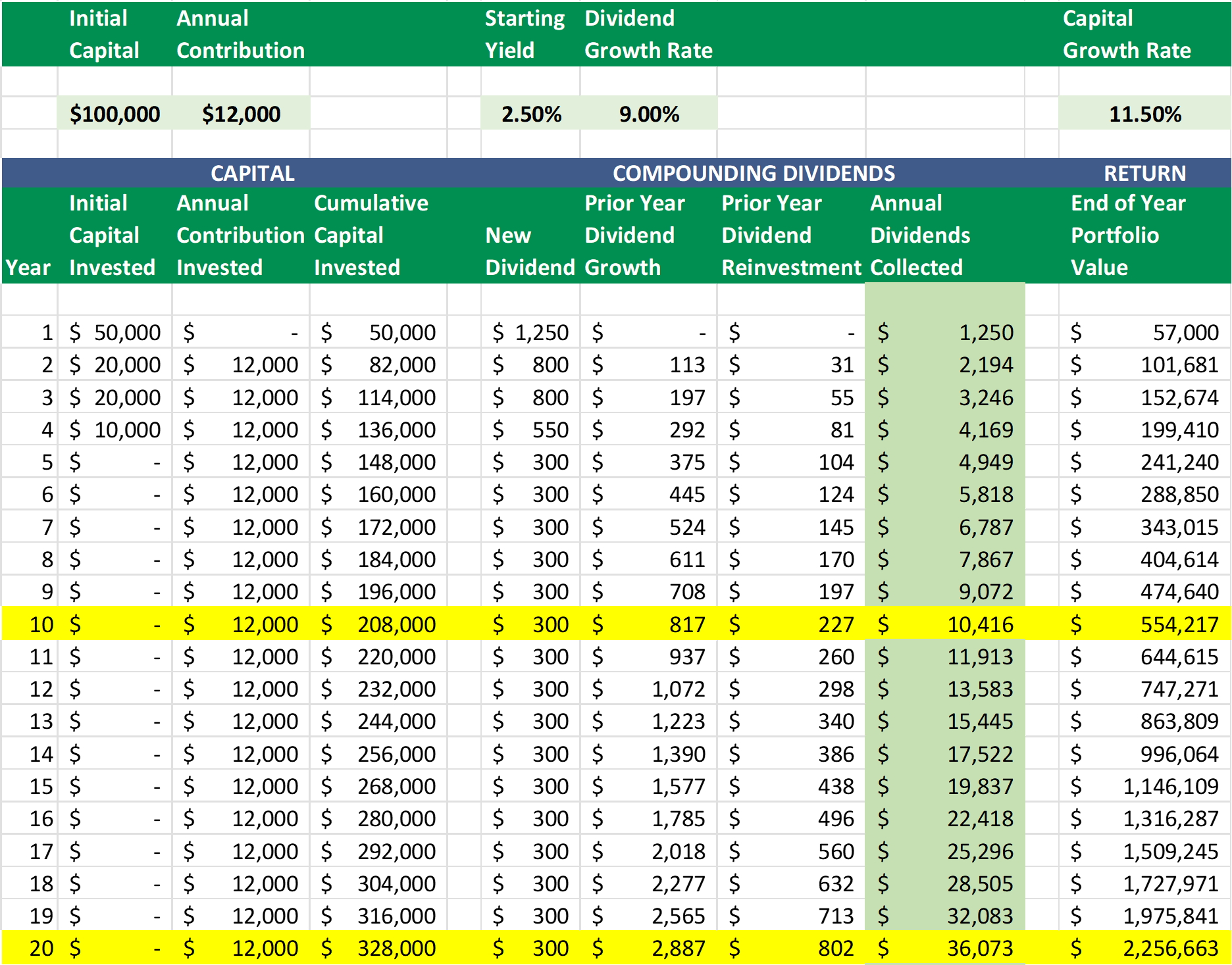
The table below illustrates how the MP Wealth-Builder Model Portfolio (USA) could potentially grow its dividend income over time under a set of reasonable and conservative assumptions:
Starting dividend yield: 2.5% on invested capital
Annual dividend growth: 9%
Annual capital growth: 11.5% (derived from yield plus dividend growth)
For simplicity, we assume that capital is invested at the beginning of each year and that dividends are collected at the end of each year.
While income growth is our primary focus, we include capital appreciation for demonstration purposes using Jack Bogle’s long-term return framework:
Future Market Returns = Dividend Yield + Earnings Growth ± Change in P/E Ratio
In our projections, we assume an 11.5% annualized capital return, based on the following rationale:
Earnings growth and dividend growth are aligned over time
Investments are made in high-quality dividend growth companies at sensible valuations
This framework provides a realistic and conservative estimate of long-term portfolio outcomes, reinforcing the central premise of this strategy: disciplined dividend growth investing can produce both rising income and competitive long-term returns.