


It’s not the dividend that has the magic, it’s the increasing dividends that drive growing wealth.
Welcome to this week’s MP Market Review, where we put our dividend growth investing (DGI) process into practice with real money, real positions, and real results.
Nearly twenty years ago, I discovered an investment philosophy that would fundamentally change how I thought about building income and wealth. Dividend growth investing gave me a process I could understand, believe in and follow through every kind of market.
No one influenced that journey more than Tom Connolly. Through his writing, Tom helped me understand the powerful relationship between growing dividends, increasing cash flow and rising share prices. His lessons became the foundation of my investment process and, eventually, much of what we do today at Magic Pants Dividend Growth Investing.
This article is my opportunity to recognize that influence and simply say: Thank you, Tom.
IN THIS ISSUE: DGI Clipboard • DGI Scorecard • DGI News • DGI Updates • Earnings Releases
DGI Clipboard
”If the dividend rises, so does the price! It’s increasing cash flow that makes a stock valuable.”
-Tom Connolly
Standing On The Shoulders of Giants
My tribute to Tom Connolly.
It has been almost twenty years since I discovered dividend growth investing.
Along the way, I have learned from many accomplished investors. But one gentleman was more instrumental than anyone else in helping me build the foundation of the dividend growth investing process I use today.
His name is Tom Connolly.
Tom, a fellow Canadian and the creator of DividendGrowth.ca, captured the essence of dividend growth investing in one wonderfully simple statement:
“If the dividend rises, so does the price. It’s increasing cash flow that makes a stock valuable.”
That idea changed how I thought about investing.
A growing dividend is not merely income deposited into an investor’s account. It is evidence of a business generating more cash and becoming more valuable. Over time, as the dividend grows, the share price tends to follow.
Dividends lead. Prices follow.
That principle remains at the heart of everything we do at Magic Pants Dividend Growth Investing.
It is why our model portfolios own quality individual companies with a demonstrated ability to grow both their dividends and their underlying businesses, often for a decade or longer.
Learning From the Giants
Tom did more than explain his own investment philosophy. Through his blog, he introduced readers to the work of other investing giants whose ideas supported the same basic premise.
Many of these observations came from books written long before mutual funds, exchange-traded funds and modern portfolio theory became dominant forces in the investment industry.
Warren Buffett:
“Intrinsic value can be defined simply: it’s the discounted value of the cash that can be taken out of a business during its remaining life.”
Benjamin Graham, Security Analysis:
“Since the market value in most cases has depended primarily upon the dividend rate, the latter can be responsible for nearly all the gains ultimately received by investors.”
Arnold Bernhard, The Valuation of Common Stocks:
“It has been found that dividend-paying ability is the final determinant of the price of a common stock.”
John Burr Williams, The Theory of Investment Value:
“For reasons which will be given in due course, we shall see fit to define investment value, therefore, as the present worth of future dividends in the case of a stock.”
Daniel Peris, The Strategic Dividend Investor:
“Stocks go up because dividends go up.”
Jack Bogle, Sources of Return
“Future Returns = Dividend Yield + Earnings Growth (Dividend Growth) ± Change in Valuation.”
Different investors. Different eras. The same underlying truth.
Ultimately, the value of a business is determined by the cash it can generate for its owners.
Turning Theory Into Evidence
Tom regularly demonstrated this relationship using his list of Canadian dividend growth companies.
He compared the growth of each company’s dividend with the long-term growth of its share price. Again and again, the two moved in the same general direction.
He also encouraged readers to study long-term dividend-yield charts.
For many established dividend growers, the yield remains within a relatively consistent historical range even as the dividend increases. If the dividend rises while the yield remains relatively stable, the share price must rise as well.
It was a simple but powerful way to see the relationship:
A growing dividend pulls the share price higher over time.
As a subscriber to Tom’s blog, I eagerly awaited each update. Each new article deepened my understanding of the strategy and strengthened my confidence in the process.
Eventually, I decided to build on what I had learned.
From Student to Portfolio Builder
I began publishing my own blog and created a watchlist of Canadian dividend growth companies, updated once each calendar year.
Over time, I expanded the process by adding categories, position-sizing rules and valuation measures based on historical fundamentals. FAST Graphs helped me study the relationship between earnings and valuation, while YCharts allowed me to create the historical dividend-yield charts that remain an important part of our analysis today.
But the foundation came from Tom:
Own high-quality businesses.
Focus on growing cash flow.
Invest in companies that consistently raise their dividends.
Pay attention to valuation.
Give time and compounding the chance to do the heavy lifting.
Most importantly, Tom’s work gave me faith in the dividend growth investing process.
That confidence eventually led me to give fellow investors a behind-the-scenes look at how a dividend growth portfolio is built, maintained and improved using real money, real positions and real results.
I committed $100,000 of my own capital to build a public-facing model portfolio, complete with timestamped buy and sell alerts for paid subscribers.
There would be no hiding the mistakes or highlighting only the winners. Every decision would be visible.
That commitment became our MP Wealth-Builder Model Portfolio (CDN).
Enjoying the Fruits of His Labour
Today, many of the companies found on The List, our watchlist of Canadian dividend growth companies, form the foundation of the Wealth-Builder Model Portfolio.
In just over four years, the portfolio’s tax-efficient dividend income has grown faster than inflation. That growing income has helped drive the value of our holdings higher and moved us steadily closer to our long-term retirement-income goal. You can find the results in our most recent Portfolio Letter dated July 31, 2026.
The performance is gratifying, but the real achievement is the process behind it.
A process built on quality, valuation, patience and growing dividends.
I may have added my own tools, measures and portfolio-management rules over the years, but the original building blocks came from the lessons Tom so generously shared.
A Timeless Strategy for all Markets
To be fair, Tom Connolly did not invent dividend growth investing. Like many great investors, he learned from someone who had already demonstrated that the strategy worked.
In 1984, Tom came across a letter published in the Financial Times of Canada. Mr. Thornton, a retired mining engineer living in Victoria, wrote it and described the remarkable results he had achieved during the first 15 years of his retirement by investing in dividend-growth stocks.
In 1968, Mr. Thornton’s portfolio generated $4,815 in annual dividend income. By 1983, that income had grown to $31,398, producing a 14.6% yield on his original investment (Growth Yield). His capital had compounded alongside his income, with the portfolio’s market value rising from $136,000 to $533,000.
What makes his achievement even more remarkable is the timing. Mr. Thornton retired in 1968, just as the market was entering a prolonged and difficult period that would last until 1982. Yet through those challenging years, his dividend income kept rising, and his portfolio value grew with it.
Any strategy that can produce rising income and long-term capital growth through an extended bear market deserves our attention.
Takeaway
We are all shaped by the people who take the time to teach us.
For me, Tom Connolly was one of those people.
His work transformed the way I invest. It gave me the confidence to build a public portfolio and ultimately inspired much of the investing philosophy we share with Magic Pants subscribers today.
This story has a wonderful continuity. More than 60 years ago, Mr. Thornton put dividend growth investing into practice. More than 40 years ago, Tom discovered his story and built on it. Years later, Tom shared what he had learned with investors like me.
Today, I am proud to carry those lessons forward.
Thank you, Tom Connolly.
The magic is in the dividend. As the dividend grows, so does the price.
DGI Scorecard
This Week’s Highlights
MP Wealth-Builder Model Portfolio (Canada)
Annualized Total Return: +17.19% since inception
Total Return (includes dividends): +16.83 % year-to-date
Dividend Growth: 7.0% year-to-date
Growth Yield: 3.2%
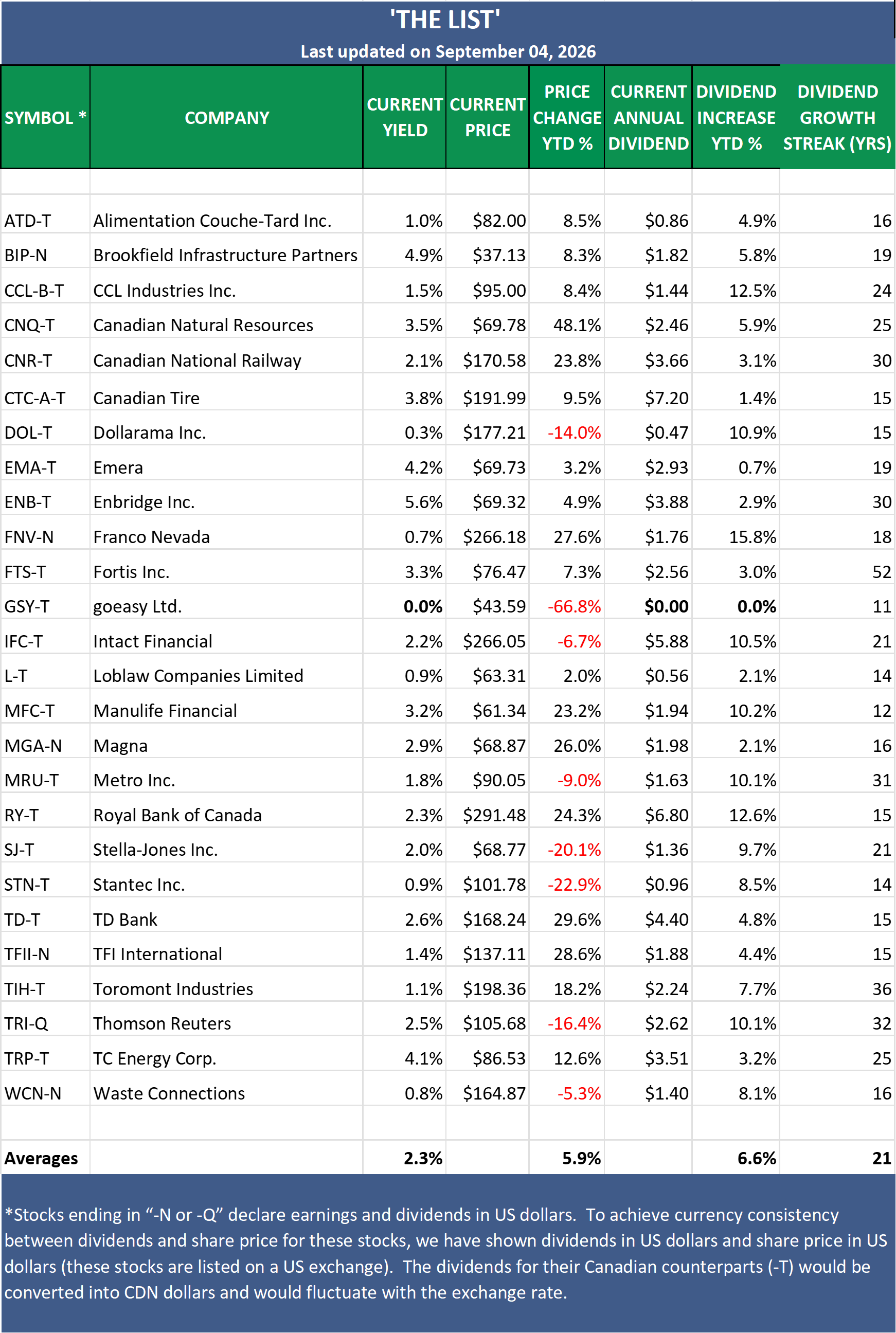
The List (Canada)
Dividend Income Growth: +6.6% year-to-date
Capital Appreciation: +5.9% year-to-date
Dividend Announcements Last Week: None
Earnings Reports Last Week: One
Earnings Reports This Week: None
Top Performers Last Week:
Loblaw Companies Limited (L-T), up +4.78%.
Magna (MGA-N), up +4.57%.
goeasy Ltd. (GSY-T), up +3.51%.
Worst Performer Last Week:
Canadian National Railway (CNR-T), down -2.56%.
Watchlists
The Magic Pants 2026 list (The List) includes 26 Canadian dividend growth stocks, and our new American watchlist (The List-USA) contains 28 companies. Here are the criteria to be considered a candidate on our watchlists:
Dividend growth streak: 10 years or more.
Market cap: Minimum one billion dollars.
Diversification: Limit of five companies per sector, preferably two per industry.
Cyclicality: Exclude REITs and pure-play energy companies due to high cyclicality.
Based on these criteria, companies are added or removed from The List annually on January 1. Prices and dividends are updated weekly.
The watchlists are not a portfolio but a coaching tool that helps us think about ideas and manage risk in our model portfolio. We own some, but not all, of the companies on these watchlists. In other words, we might want to buy these companies when valuation looks attractive.
Our newsletter provides readers with a comprehensive insight into the implementation and advantages of our dividend growth investing strategy. This evidence-based, unbiased approach empowers DIY investors to outperform both actively managed dividend funds and passively managed indexes and dividend ETFs over longer-term horizons.
In the last week of every month, I will show the updated watchlist for our American dividend growers (The List-USA). I will show the watchlist after the Canadian watchlist above.
New to Magic Pants?
Magic Pants Dividend Growth Investing is a behind-the-scenes look at how we build, maintain, and improve a dividend growth portfolio using real money, real positions, and real results.
Our objective is to grow dividend income by 7-10%+ annually while achieving long-term capital appreciation that matches or exceeds the broader market over a full investing cycle.
The name comes from a simple idea: when a quality company pays a dividend, cash moves from the company’s pocket to yours while your ownership stake remains intact. As earnings and dividends grow, the compounding cycle can accelerate. That’s the magic.
Build Your Own Growing Income Machine
Looking for a helping hand in the market? Members of Magic Pants Dividend Growth Investing receive exclusive ideas and guidance designed to help navigate changing market conditions.
The Magic Pants model portfolios (Canadian and American) are real-money, dividend-growth portfolios funded with actual capital and executed in live accounts. We own, size, and track every position in real time using our disciplined DGI process.
Become a paid subscriber and see exactly how we put the process into practice. You’ll also receive full access to this post and exclusive subscriber-only content.
We do the work. You stay in control.
From breaking news and quarterly earnings to the latest dividend announcements, we highlight what matters most and explain what it means for dividend growth investors.
