


Summary
This is not a stock-picking newsletter.
It’s a behind-the-scenes look at how a dividend growth portfolio is built, maintained, and improved over time.
Welcome to this week’s MP Market Review. Each week, we track the Canadian dividend growth companies on The List, our curated watchlist of businesses designed to produce rising income. While we also publish a U.S. edition monthly, Canada remains our training ground.
Our objective is simple: grow dividend income by 7–10%+ annually while delivering capital appreciation that matches or exceeds the TSX Composite in Canada and the S&P 500 for our U.S. investors over a full market cycle.
What you’re about to read isn’t theory. It’s the real-time application of a dividend growth strategy using real money, with a clear objective: growing income first and letting capital growth follow.
Markets generate a lot of noise. We ignore most of it.
Instead, we track a small set of metrics that tell us whether our dividend growth strategy is working in real time. No forecasts. No opinions. Just results.
Here they are:
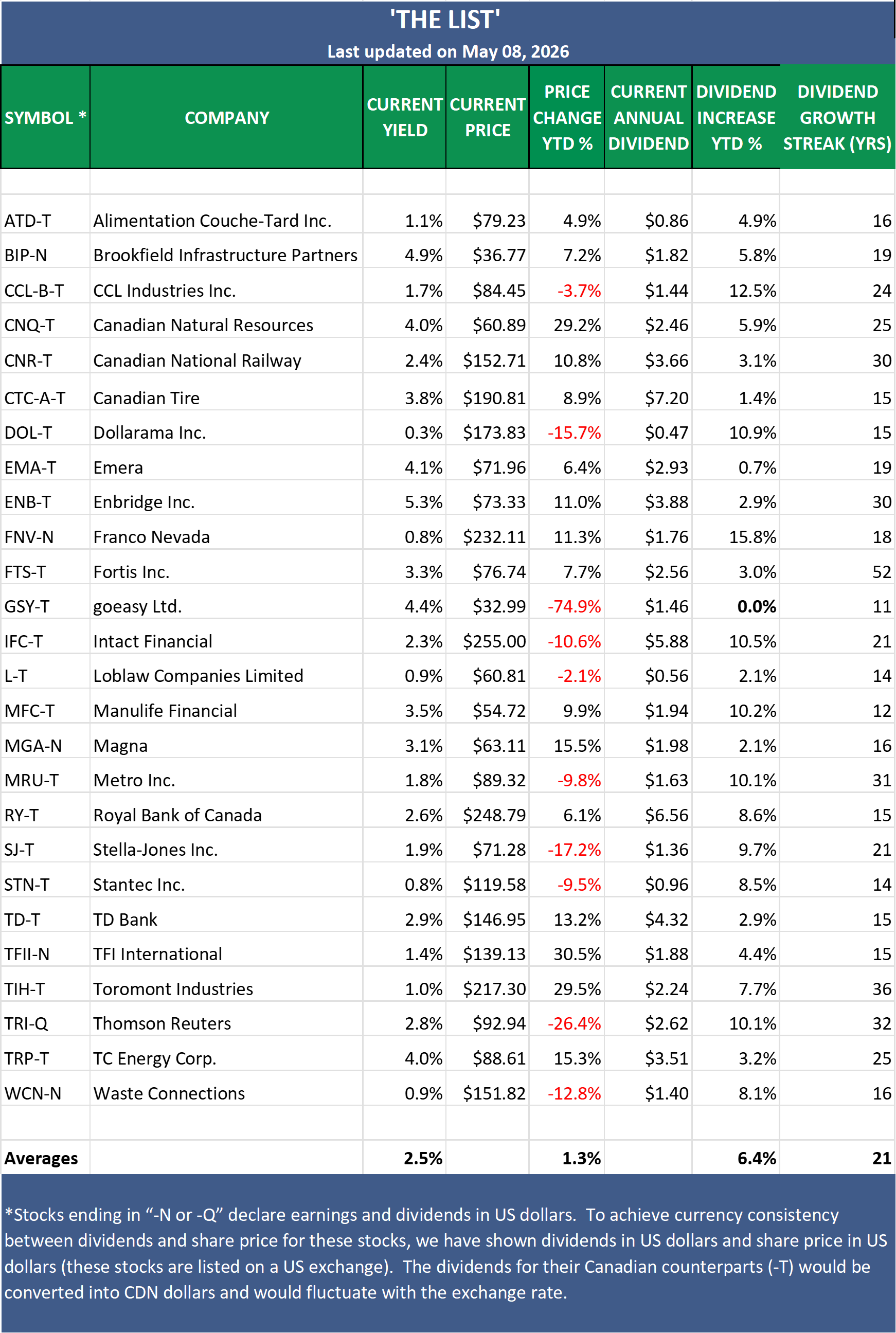
Dividend income from The List: +6.4% year-to-date
Capital value: +1.3% year-to-date
Dividend announcements last week: None
Earnings reports last week: Six
Earnings reports this week: Eight
DGI Clipboard
“My life has been a product of compound interest. Nothing more. Nothing less. And nothing brilliant.”
- Warren Buffett
The Rule of 72: A Dividend Growth Perspective
Portfolio prices fluctuate constantly up and down. Income from quality dividend growers tends to move in one direction: upward.
If you are young and new to investing, at some point a wealth advisor will sit you down and explain the Rule of 72. They will pull up long-term charts showing the historical returns of the stock market over the last 10, 20, or 30 years and explain how your money could double roughly every decade at a 7% annual return (historical long term stock market return).
The projections look impressive.
Add regular contributions and the magic of compounding, and suddenly retirement in your late fifties or early sixties feels almost guaranteed.
You hand over your hard-earned savings, believing that historical returns will continue and that, one day, your portfolio will grow large enough to fund retirement by slowly selling off pieces of it.
That is the traditional narrative.
The problem with this approach is that most investors are taught to think about the Rule of 72 in terms of portfolio value and stock prices which can be unpredictable year by year. This causes growth only investors to panic over a full investing cycle and often interrupt the compounding process. Management fees eat away at capital and only a few make it to retirement with their original portfolio goals intact.
Dividend growth investors see the equation differently.
The real power is not in the account balance.
It is in the income stream.
Instead of focusing on what the portfolio is worth on any given day, we focus on how much cash flow it produces and, more importantly, how quickly that income grows over time.
A portfolio generating rising dividend income year after year changes the conversation entirely. You are no longer focused on the market in the short term or relying exclusively on selling assets to fund retirement one day. It is much easier to stay the course and let compounding do the heavy lifting.
That shift in mindset is what separates ownership thinking from market thinking.
What Is the Rule of 72?
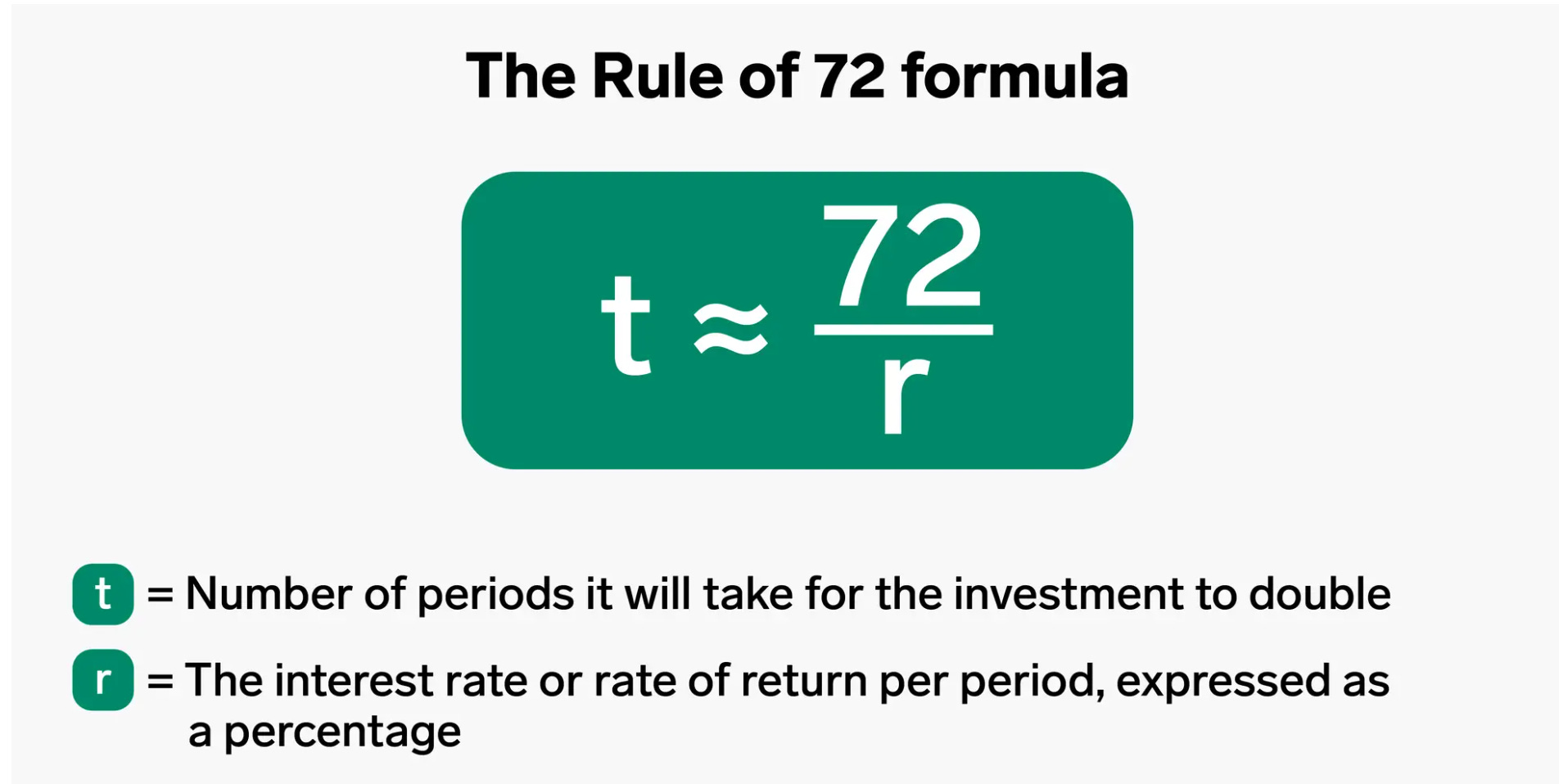
The Rule of 72 is a shortcut investors use to estimate how long it takes money to double.
Why the Rule of 72 Matters More for Dividend Growth Investors
Most traditional investors think in terms of portfolio value.
Dividend growth investors think in terms of income growth.
That distinction matters because income is what ultimately funds retirement, financial freedom, and long-term independence.
Portfolio prices fluctuate constantly up and down.
Income from quality dividend growers tends to move in one direction: upward.
This is why the Rule of 72 fits dividend growth investing so perfectly.
If your portfolio income compounds at 7% annually, your income doubles approximately every 10 years.
A portfolio generating $10,000 in income today becomes:
$20,000 in about 10 years
$40,000 in about 20 years
$80,000 in about 30 years
Without adding extraordinary amounts of new capital.
Just compounding.
Just dividend growth.
Just patience.
This is the real power of dividend growth investing.
The Part Most Investors Miss
Here is the critical insight:
Dividend growth and price appreciation are not separate forces.
They come from the same source: growing earnings.
Businesses that consistently grow earnings can:
Raise dividends
Reinvest capital
Expand cash flow
Increase intrinsic value
Over long periods, stock prices tend to follow dividend growth because both reflect the growth of the underlying business.
This is why we constantly repeat the same principle at Magic Pants Dividend Growth Investing:
Income is built first.
Capital appreciation follows.
The Rule of 72 helps investors visualize that process.
A company growing dividends at 7% annually is quietly doubling the income it pays shareholders every ten years.
And over time, markets usually recognize that growth.
Don’t be surprised if your capital grows at a similar or even faster rate. After all, we only buy quality dividend growers when they are sensibly priced.
Takeaway
The Rule of 72 is not complicated.
But it explains one of the most important truths in dividend growth investing:
Small, consistent growth rates become life-changing over long periods.
That is why we focus so heavily on:
Earnings growth
Dividend growth
Quality businesses
Long holding periods
Patience
Markets will always fluctuate.
Headlines will always create noise.
But when your income stream keeps doubling every decade, eventually the math overwhelms the volatility.
That is the real secret behind dividend growth investing.
Not prediction.
Compounding.
Looking for a helping hand in the market? Members of Magic Pants Dividend Growth Investing get exclusive ideas and guidance to navigate any climate.
The Magic Pants model portfolios (Canadian and American) are real-money, dividend-growth portfolios funded with actual capital and executed in live accounts. Every position shown is owned, sized, and tracked in real time using our disciplined DGI process.
Become a PAID subscriber, and I’ll show you exactly how I do it. In addition, gain full access to this post and exclusive, subscriber-only content. We do the work; you stay in control!
DGI Scorecard
The Magic Pants 2026 list (The List) includes 26 Canadian dividend growth stocks, and our new American watchlist (The List-USA) contains 28 companies. Here are the criteria to be considered a candidate on our watchlists:
Dividend growth streak: 10 years or more.
Market cap: Minimum one billion dollars.
Diversification: Limit of five companies per sector, preferably two per industry.
Cyclicality: Exclude REITs and pure-play energy companies due to high cyclicality.
Based on these criteria, companies are added or removed from ‘The List’ annually on January 1. Prices and dividends are updated weekly.
‘The List’ is not a portfolio but a coaching tool that helps us think about ideas and risk-manage our model portfolio. We own some, but not all, of the companies on ‘The List’. In other words, we might want to buy these companies when valuation looks attractive.
Our newsletter provides readers with a comprehensive insight into the implementation and advantages of our dividend growth investing strategy. This evidence-based, unbiased approach empowers DIY investors to outperform both actively managed dividend funds and passively managed indexes and dividend ETFs over longer-term horizons.
Note: In the last week of every month, I will show the updated watchlist for our American dividend growers, The List-USA. It will be shown after the Canadian watchlist below.
Performance of 'The List'
The dividend growth of The List stayed the same last week, with an average YTD increase of 6.4% (income).
The price of The List was down last week and now stands at +1.3% YTD (capital).
Top Performers Last Week:
Magna (MGA-N), up +3.75%.
Manulife Financial (MFC-T), up +2.86%.
Franco Nevada (FNV-N), up +2.50%.
Worst Performer Last Week:
Stella-Jones Inc. (SJ-T), down -13.06%.
From breaking news to quarterly earnings reports, we break down the week’s biggest headlines to help you make sense of the market.
