


Summary
This is not a stock-picking newsletter.
It’s a behind-the-scenes look at how a dividend growth portfolio is built, maintained, and improved over time.
Welcome to this week’s MP Market Review. Each week, we track the Canadian dividend growth companies on The List, our curated watchlist of businesses designed to produce rising income. While we also publish a U.S. edition monthly, Canada remains our training ground.
Our objective is simple: grow dividend income by 7–10%+ annually while delivering capital appreciation that matches or exceeds the TSX Composite in Canada and the S&P 500 for our U.S. investors over a full market cycle.
What you’re about to read isn’t theory. It’s the real-time application of a dividend growth strategy using real money, with a clear objective: growing income first and letting capital growth follow.
Markets generate a lot of noise. We ignore most of it.
Instead, we track a small set of metrics that tell us whether our dividend growth strategy is working in real time. No forecasts. No opinions. Just results.
Here they are:
Dividend income from The List: +6.4% year-to-date
Capital value: +1.7% year-to-date
Dividend announcements last week: None
Earnings reports last week: Two
Earnings reports this week: Six
DGI Clipboard
“This is one of the keys to successful investing: focus on the companies, not on the stocks.”
– Peter Lynch
Think Like an Owner
Ownership Thinking
For us, investing is about owning businesses, not trading stocks.
We approach every purchase with an ownership mindset, as if we were acquiring a meaningful stake in the company. This perspective keeps us steady during market volatility and strengthens our long-term commitment.
It also forces a deeper level of understanding. We are aligning with high-quality businesses, led by capable management teams and supported by thousands of employees doing the real work. Their success is what ultimately drives our income and long-term returns.
Our portfolio is not a list of tickers.
We treat it like an asset management business, with dividend growth companies as the core assets and us as the CEO. That framing matters. It shifts the focus toward building something durable that produces both rising income and long-term capital appreciation.
This is what reinforces our “rarely sell” philosophy.
Through all market conditions, we follow the same playbook.
Add more when prices are attractive.
Let the businesses compound when conditions improve.
Over time, the shift happens.
You move from working for your money to managing assets that work for you.
You already know this.
Most investors just don’t act like it.
When you buy a stock, you are not trading a ticker. You are buying a slice of a real business. That has consequences.
If you buy shares of Royal Bank of Canada, you are making a valuation decision on the entire enterprise. You are saying, at today’s price, this business is worth owning based on what it can produce going forward.
It does not matter that you are only buying a few shares.
The mindset should be the same.
This is where most investors lose the plot.
They focus on price.
They watch screens.
They react to headlines.
Owners do something different.
They focus on the business.
Think about it this way.
Imagine you own a small, family-run HVAC company.
Your grandfather started it. Your parents expanded it. Now you are responsible for running it and eventually passing it on.
The business generates steady cash flow. Customers depend on it. Growth is not explosive, but it is consistent.
Now ask yourself what actually matters.
Do you care what someone offers you for the business today?
No.
What matters is simple.
How much cash does it produce?
Will that cash grow over time?
That’s it.
Income and growth.
Everything else is noise.
This is the exact lens we should use for our dividend growth portfolios.
When we buy a quality company, we are stepping into ownership of a cash-generating asset. The job is not to predict price moves. The job is to assess whether the business can grow earnings and dividends over time.
If it can, the rest follows.
Dividends rise.
Income compounds.
Price eventually catches up.
Takeaway
This is where dividend growth investing separates itself from speculation.
We are not relying on someone else to pay us more tomorrow.
We are relying on the business to produce more cash next year than it did this year.
That is a far more durable edge.
From trading to owning.
From price to income.
From noise to process.
Get this right, and everything else gets easier.
Looking for a helping hand in the market? Members of Magic Pants Dividend Growth Investing get exclusive ideas and guidance to navigate any climate.
The Magic Pants model portfolios (Canadian and American) are real-money, dividend-growth portfolios funded with actual capital and executed in live accounts. Every position shown is owned, sized, and tracked in real time using our disciplined DGI process.
Become a PAID subscriber, and I’ll show you exactly how I do it. In addition, gain full access to this post and exclusive, subscriber-only content. We do the work; you stay in control!
DGI Scorecard
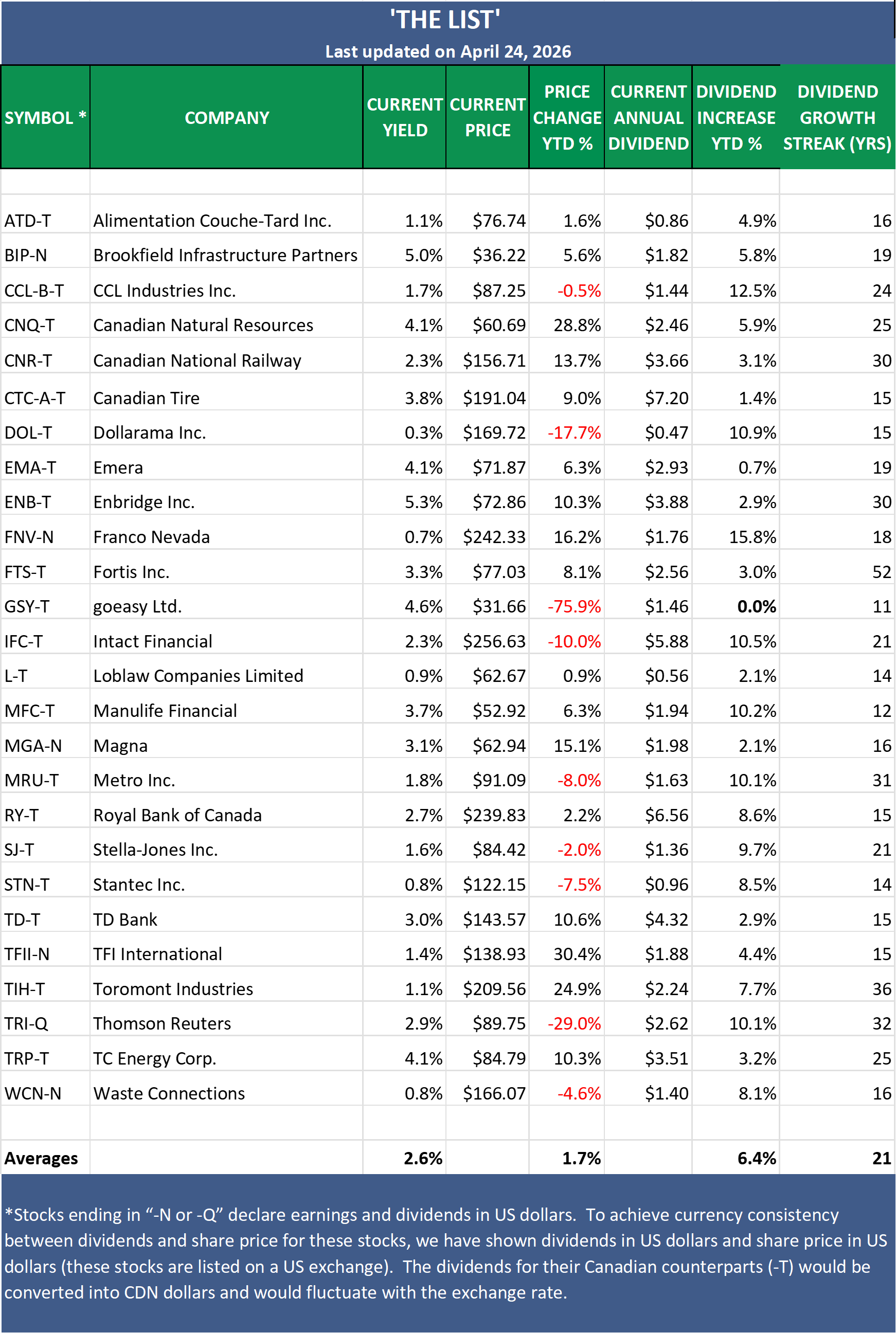
The Magic Pants 2026 list (The List) includes 26 Canadian dividend growth stocks, and our new American watchlist (The List-USA) contains 28 companies. Here are the criteria to be considered a candidate on our watchlists:
Dividend growth streak: 10 years or more.
Market cap: Minimum one billion dollars.
Diversification: Limit of five companies per sector, preferably two per industry.
Cyclicality: Exclude REITs and pure-play energy companies due to high cyclicality.
Based on these criteria, companies are added or removed from ‘The List’ annually on January 1. Prices and dividends are updated weekly.
‘The List’ is not a portfolio but a coaching tool that helps us think about ideas and risk-manage our model portfolio. We own some, but not all, of the companies on ‘The List’. In other words, we might want to buy these companies when valuation looks attractive.
Our newsletter provides readers with a comprehensive insight into the implementation and advantages of our dividend growth investing strategy. This evidence-based, unbiased approach empowers DIY investors to outperform both actively managed dividend funds and passively managed indexes and dividend ETFs over longer-term horizons.
Note: In the last week of every month, I will show the updated watchlist for our American dividend growers, The List-USA. It will be shown after the Canadian watchlist below.
Performance of 'The List'
The dividend growth of The List stayed the same last week, with an average YTD increase of 6.4% (income).
The price of The List was down last week and now stands at +1.7% YTD (capital).
Top Performers Last Week:
TFI International (TFII-N), up +5.56%.
Waste Connections (WCN-N), up +4.03%.
Magna (MGA-N), up +3.93%.
Worst Performer Last Week:
Franco Nevada (FNV-N), down -7.68%.
From breaking news to quarterly earnings reports, we break down the week’s biggest headlines to help you make sense of the market.
