


Summary
This is not a stock-picking newsletter!
It’s a behind-the-scenes look at how a dividend growth portfolio is built, maintained, and improved over time.
Welcome to this week’s MP Market Review.
Before we begin, a quick explanation of the name.
Many years ago, when I first discovered dividend growth investing, I came across a quote that stopped me in my tracks:
“You have a pair of pants. In the left pocket, you have $100. You take $1 out of the left pocket and put it in the right pocket. You now have $101. There is no diminution of dollars in your left pocket. That is one magic pair of pants.”
That is dividend growth investing in its simplest form.
When a quality company pays a dividend, cash moves from the company’s pocket to yours, yet your ownership stake remains intact. As earnings grow, dividends tend to grow. As dividends grow, share prices often follow. Reinvest those dividends into additional shares, and the cycle accelerates: more shares generate more dividends, which buy even more shares.
That’s the magic.
It’s why we call this newsletter Magic Pants Dividend Growth Investing.
Every week, we track the companies on The List, our curated watchlist of Canadian dividend growth businesses selected for their ability to produce rising income over time. While we also publish a U.S. edition each month, Canada remains our primary hunting ground.
Our objective is straightforward:
Grow dividend income by 7-10%+ annually while achieving long-term capital appreciation that matches or exceeds the TSX Composite in Canada and the S&P 500 in the United States.
What follows is not theory.
It is the real-world application of a dividend growth strategy using real money, real positions, and real results.
Markets create an endless stream of noise. We ignore most of it.
Instead, we focus on a handful of metrics that tell us whether our process is working. No predictions. No forecasts. No crystal ball.
Just results.
The magic is in the dividend. Dividends lead. Prices follow.
This Week’s Scorecard
MP Wealth-Builder Model Portfolio (Canada)
Annualized Total Return: +17.25% since inception
Total Return (includes dividends): +15.80% year-to-date
Current Yield: 3.2%
The List (Canada)
Dividend Income Growth: +6.6% year-to-date
Capital Appreciation: +7.4% year-to-date
Dividend Announcements Last Week: None
Earnings Reports Last Week: None
Earnings Reports This Week: None
DGI Clipboard
“Current yield, using its own historic yield as a guide, is, in my view, a fine valuation measure.”
— Tom Connolly
Timely Ten: Where the Best Dividend Bargains Are Hiding This Month
Timely Ten Update
There was no change to the Canadian Timely Ten this month. The same ten companies continue to rank as the most undervalued names on our Canadian watchlist.
Similar to last month, seven of the Timely Ten increased in price over the past thirty days, highlighting just how quickly quality businesses can become less attractive from a valuation perspective. Only Alimentation Couche-Tard Inc. remains undervalued by double digits based on our valuation methodology. Overall, it is becoming increasingly difficult to find compelling value in the Canadian market.
That isn’t necessarily a reason to stop investing. Rather, it reinforces the importance of patience and discipline. When valuations become stretched, we continue to build positions incrementally, allowing market volatility to dictate the pace of our purchases rather than emotions. History has shown that attractive buying opportunities eventually return, and maintaining a watchlist of high-quality businesses ensures we are ready when they do.
More Opportunity South of the Border
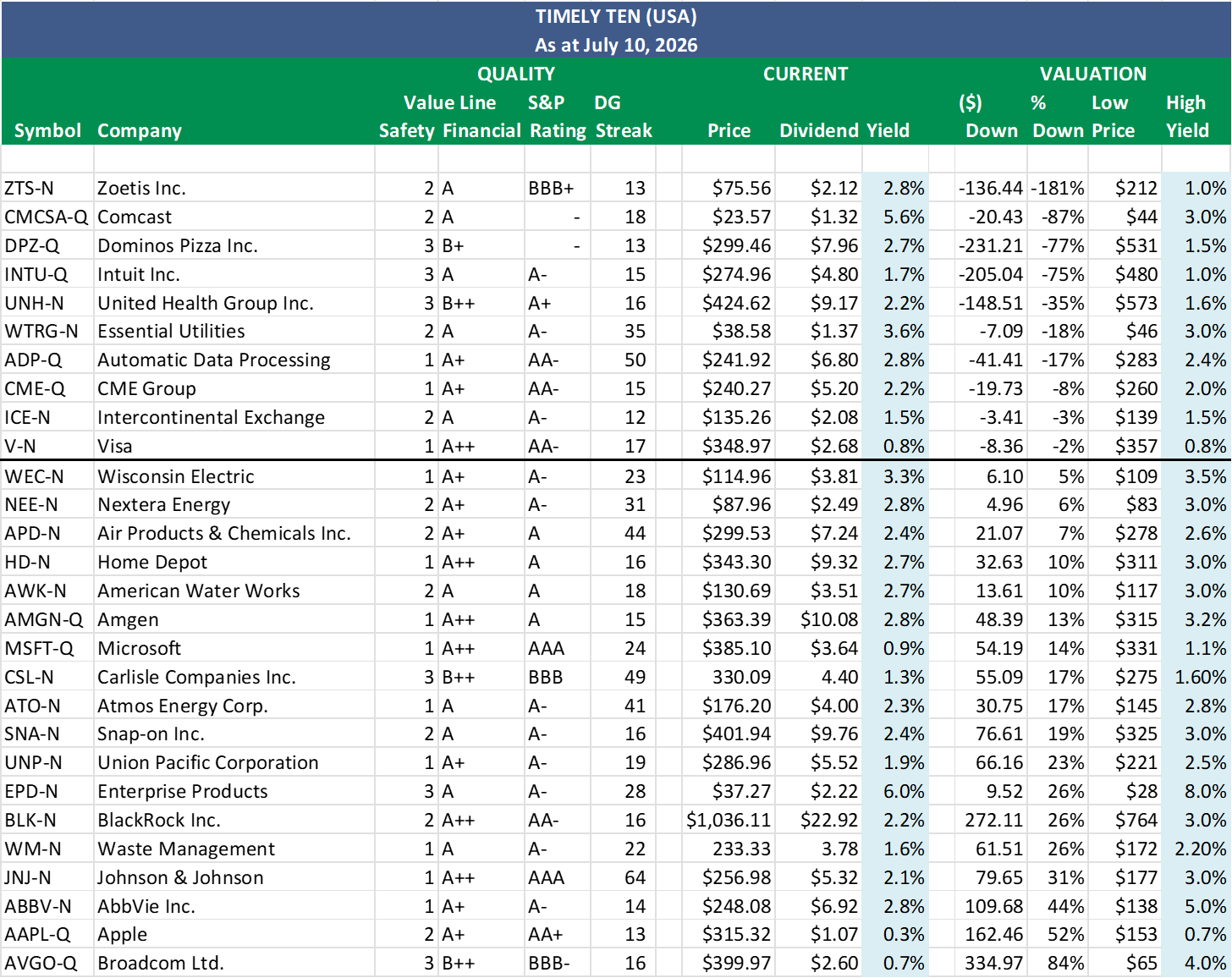
The American Timely Ten continues to offer more opportunity, with noticeably greater movement throughout the rankings. The top four companies remain unchanged and are largely trading sideways, but there has been meaningful movement in the middle of the list.
UnitedHealth Group, Automatic Data Processing, and Visa all moved lower on the list this month on improving share prices, and we are hopeful that they may soon graduate from the Timely Ten. We own all three in our MP Wealth-Builder Model Portfolio (USA), and our disciplined approach of adding to these positions during periods of weakness is beginning to pay off.
CME Group: Short-Term Weakness, Long-Term Opportunity
The biggest mover this month was CME Group (CME-Q), which climbed from twelfth to eighth on the list following recent share price weakness.
The decline was largely driven by UBS lowering its earnings estimates and price target after second-quarter average daily trading volume came in below expectations. Trading activity was softer in interest rate and energy futures, two of CME’s largest product categories, leading to concerns about near-term transaction revenue.
While these issues may create short-term headwinds, they have done little to alter our long-term investment thesis for this exceptional business.
Air Products: Capital Discipline Rewarded
Air Products & Chemicals (APD-N) moved in the opposite direction, falling from ninth to thirteenth after a strong rally in its share price.
Investor sentiment improved after management cancelled several large capital-intensive clean energy projects, a move widely viewed as evidence of greater capital discipline rather than weakening prospects. Management also reaffirmed progress on its flagship NEOM Green Hydrogen Project in Saudi Arabia, further supporting investor confidence.
Volatility Creates Opportunity
These shifts once again demonstrate why we focus on valuation rather than headlines. Quality companies frequently move in and out of favour, creating opportunities for patient long-term investors.
We recently added to both CME Group(CME-Q) and Intercontinental Exchange (ICE-N) within our MP Wealth-Builder Model Portfolio (USA), reinforcing our view that the Timely Ten remains one of the most productive hunting grounds for identifying high-quality dividend growth companies trading at sensible prices.
The Timely Ten is published monthly and ranks the most undervalued dividend growth companies in Canada and the United States. The rankings are based on Dividend Yield Theory, a valuation framework that I explain in greater detail later in this article.
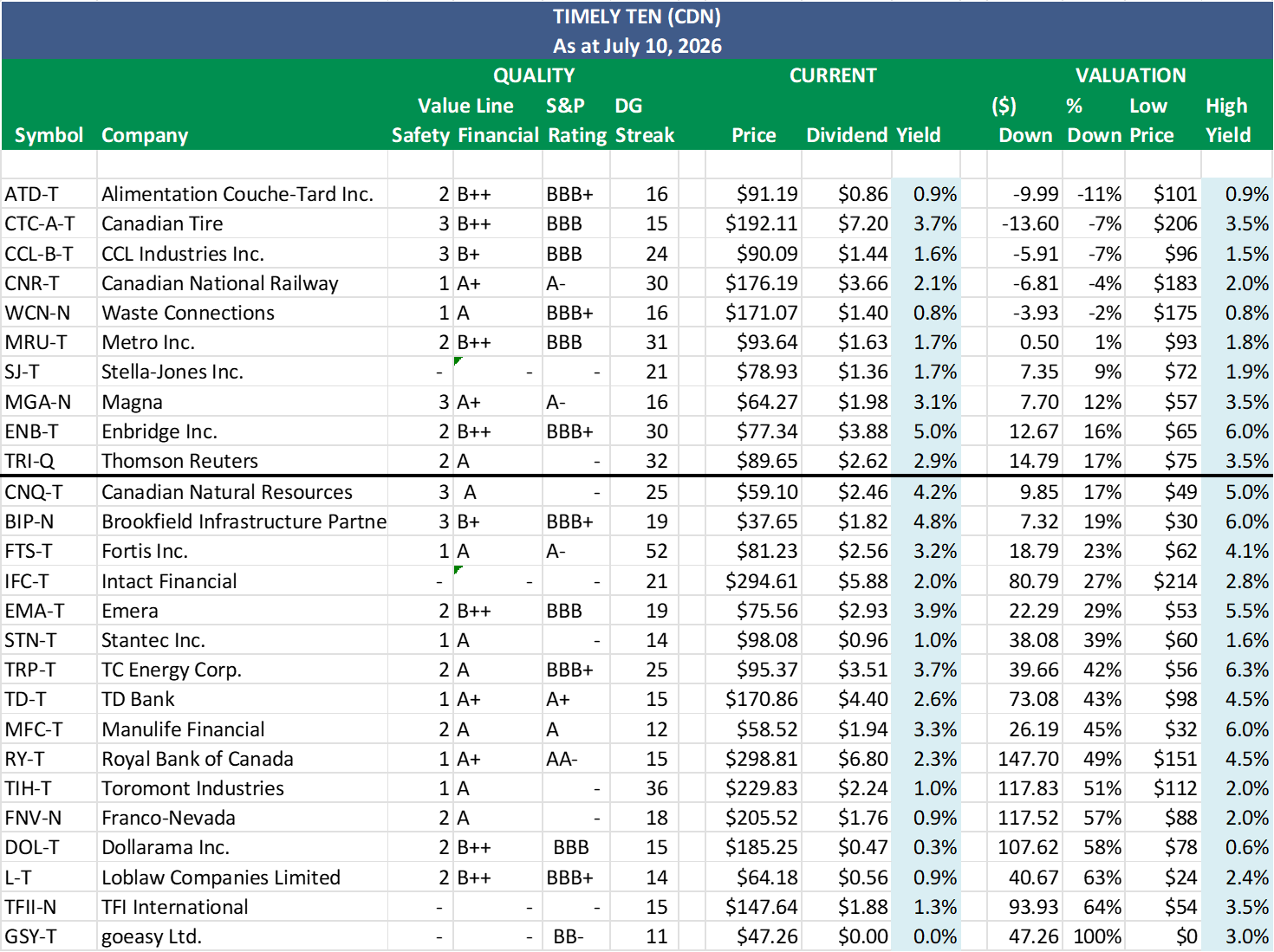
Note: goeasy Ltd.’s dividend has been suspended, so we have moved it to the bottom of the list.
Background
The third step in our investment process is monitoring. Once we’ve identified high-quality dividend growth companies and purchased them at sensible prices, we continuously monitor them for changes in valuation and business fundamentals.
Tracking dozens of companies can quickly become overwhelming. Fortunately, our focus is limited to the businesses on our watchlists rather than the thousands of stocks that make up the broader market. Even so, we are always looking for ways to improve the efficiency and consistency of our process. One of the most valuable tools we have found is Dividend Yield Theory.
What Is Dividend Yield Theory?
Dividend Yield Theory is a straightforward valuation method based on a simple observation: the dividend yields of mature, high-quality dividend growth companies tend to fluctuate around a historical average over time, provided the underlying business remains fundamentally intact.
Because a stock’s price and dividend yield move in opposite directions, a higher-than-normal dividend yield often signals that the shares are trading below their historical valuation. Conversely, an unusually low dividend yield may indicate that the shares have become expensive.
Dividend Yield Theory doesn’t tell us what to buy. Our quality screening process does that. Instead, it helps us determine when to buy.
Building the Watchlist
Before applying Dividend Yield Theory, every company must first qualify for our watchlist by meeting our quality standards.
Dividend growth: Minimum 10 consecutive years of dividend increases.
Market capitalization: At least $1 billion.
Diversification: Maximum of five companies per sector, with a preference for no more than two per industry.
Business quality: We generally exclude REITs and pure-play energy companies because their earnings and dividends tend to be more cyclical.
This quality-first approach dramatically reduces the investment universe and allows us to focus only on exceptional businesses.
How We Rank the Timely Ten
Each month, we rank every company on our Canadian and U.S. watchlists by the discount between its current market price and its estimated fair value, based on Dividend Yield Theory.
Fair value is calculated using a simple formula:
Fair Value = Current Annual Dividend ÷ Historical High Dividend Yield
The larger the discount to fair value, the higher the company ranks.
The ten companies above the thick black line are trading below their estimated fair values and currently offer dividend yields higher than their historical highs. These companies have historically provided the best combination of quality, valuation, and upside potential.
These are our Timely Ten.
While no valuation method is perfect, Dividend Yield Theory has proven to be an exceptionally effective way to identify attractive entry points for high-quality dividend growth companies. Used alongside our quality-first investment process, it helps us deploy capital with greater discipline while removing much of the emotion from investment decisions.
Takeaway
The Timely Ten is not about chasing performance. It is about patiently allocating new capital to outstanding businesses when the odds are tilted in our favour. Over a full market cycle, buying great companies at sensible prices has proven to be one of the simplest and most effective ways to build both a growing stream of dividend income and long-term capital appreciation.
Looking for a helping hand in the market? Members of Magic Pants Dividend Growth Investing get exclusive ideas and guidance to navigate any climate.
The Magic Pants model portfolios (Canadian and American) are real-money, dividend-growth portfolios funded with actual capital and executed in live accounts. Every position shown is owned, sized, and tracked in real time using our disciplined DGI process.
Become a PAID subscriber, and I’ll show you exactly how I do it. In addition, gain full access to this post and exclusive, subscriber-only content. We do the work; you stay in control!
DGI Scorecard
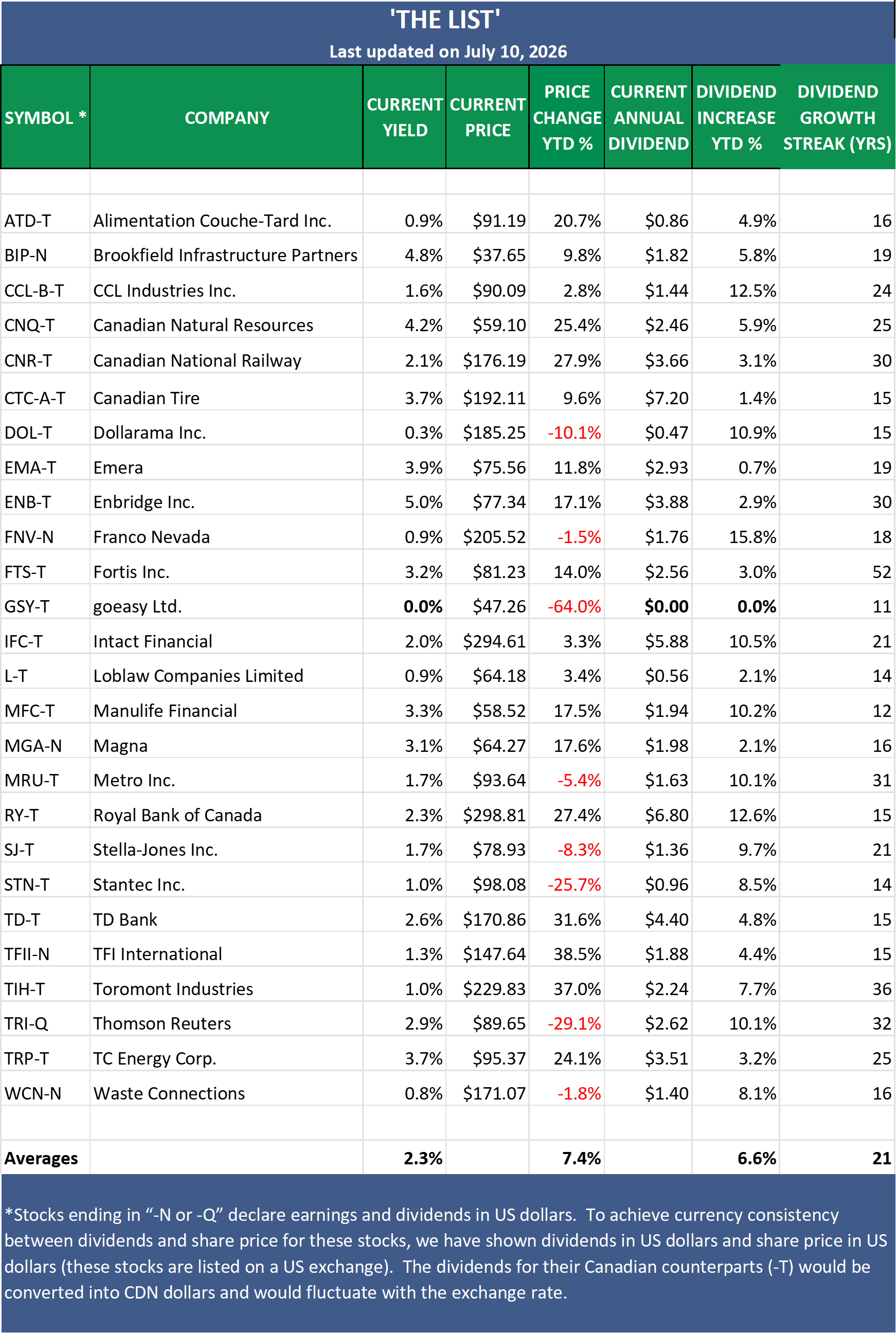
The Magic Pants 2026 list (The List) includes 26 Canadian dividend growth stocks, and our new American watchlist (The List-USA) contains 28 companies. Here are the criteria to be considered a candidate on our watchlists:
Dividend growth streak: 10 years or more.
Market cap: Minimum one billion dollars.
Diversification: Limit of five companies per sector, preferably two per industry.
Cyclicality: Exclude REITs and pure-play energy companies due to high cyclicality.
Based on these criteria, companies are added or removed from ‘The List’ annually on January 1. Prices and dividends are updated weekly.
‘The List’ is not a portfolio but a coaching tool that helps us think about ideas and risk manage our model portfolio. We own some but not all the companies on ‘The List’. In other words, we might want to buy these companies when valuation looks attractive.
Our newsletter provides readers with a comprehensive insight into the implementation and advantages of our dividend growth investing strategy. This evidence-based, unbiased approach empowers DIY investors to outperform both actively managed dividend funds and passively managed indexes and dividend ETFs over longer-term horizons.
Note: In the last week of every month, I will show the updated watchlist for our American dividend growers, The List-USA. It will be shown after the Canadian watchlist below.
Performance of 'The List'
The dividend growth for The List remained unchanged last week, with an average YTD increase of 6.6% (income).
The price of The List was up last week and now stands at +7.4% YTD (capital).
Top Performers Last Week:
TFI International (TFII-N), up +6.11%.
Canadian Natural Resources (CNQ-T), up +4.27%.
Metro Inc. (MRU-T), up +3.92%.
Worst Performer Last Week:
Franco Nevada (FNV-N), down -5.54%.
From breaking news to quarterly earnings reports, we break down the week’s biggest headlines to help you make sense of the market.
