


Summary
Welcome to this week’s MP Market Review – your go-to source for insights and updates on the Canadian dividend growth companies we track on ‘The List’! While we’ve expanded our watchlists to include U.S. companies (The List-USA), our Canadian lineup remains the cornerstone of our coaching approach.
Don’t miss out on exclusive newsletters and premium content that will help you sharpen your investing strategy. Explore it all at magicpants.substack.com.
Your journey to dividend growth mastery starts here – let’s dive in!
Last week, dividend growth was up, with an average return of +7.5% YTD (income).
Last week, the price of 'The List' was up from the previous week with an average return of -1.20% YTD (capital).
Last week, there were no dividend announcements from companies on 'The List'.
Last week, there were no earnings reports from companies on 'The List'.
This week, one company on 'The List' will report on earnings.
DGI Clipboard
“On the news they say ‘markets’ are roiling. The markets. We are not in the market. We are investors. We buy fine companies for the dividend. Then the company pays us directly. No market, no third party. No wealth managers.”
— Tom Connolly
Timely Ten: Why Yield Acts as a Price Floor for Dividend Growth Stocks
Intro
Last week was a clear reminder of the importance of staying the course. Those who panicked and sold are likely regretting it now—patience and discipline once again proved to be the investor’s greatest advantage.
When the broader market sells off, the share prices of even high-quality dividend growth stocks can fall. But as their prices drop, their dividend yields rise (since yield = dividend ÷ price). At a certain point, the higher yield becomes too attractive for investors to ignore, especially for income-focused or value-conscious buyers.
This rising yield acts like a magnet, drawing in new buyers who want that growing income stream. As demand increases, the stock price stabilizes and often rebounds, creating a natural price floor.
This dynamic is especially strong with dividend growth stocks because:
Their dividends are reliable (often backed by decades of increases).
Investors trust the payout will keep rising, even during downturns.
Retirees, institutions, and income-seekers step in when yields get juicy.
So, while growth stocks might keep falling in a panic, dividend growth stocks often find support sooner because the rising yield makes them increasingly attractive the lower they go.
Timely Ten
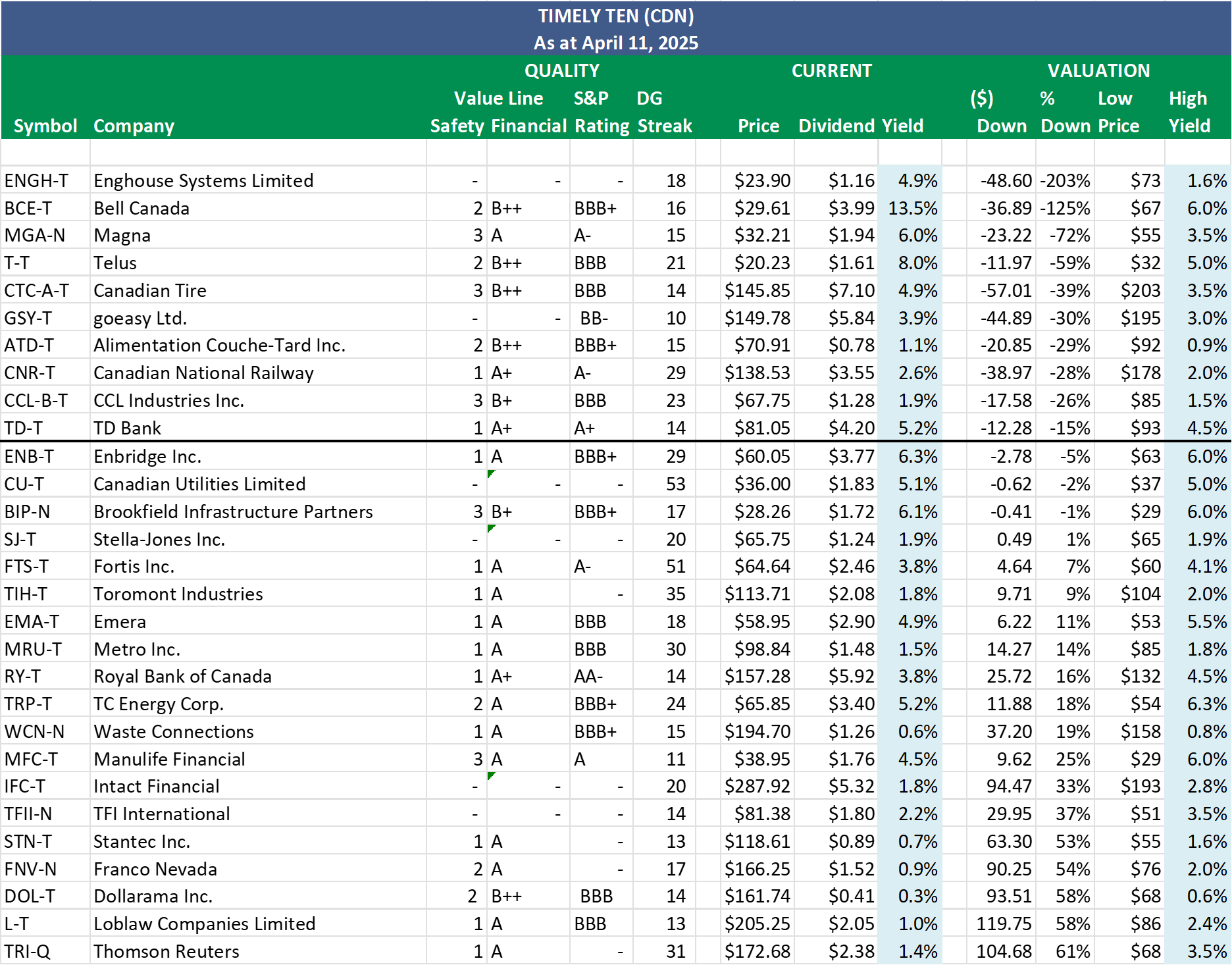
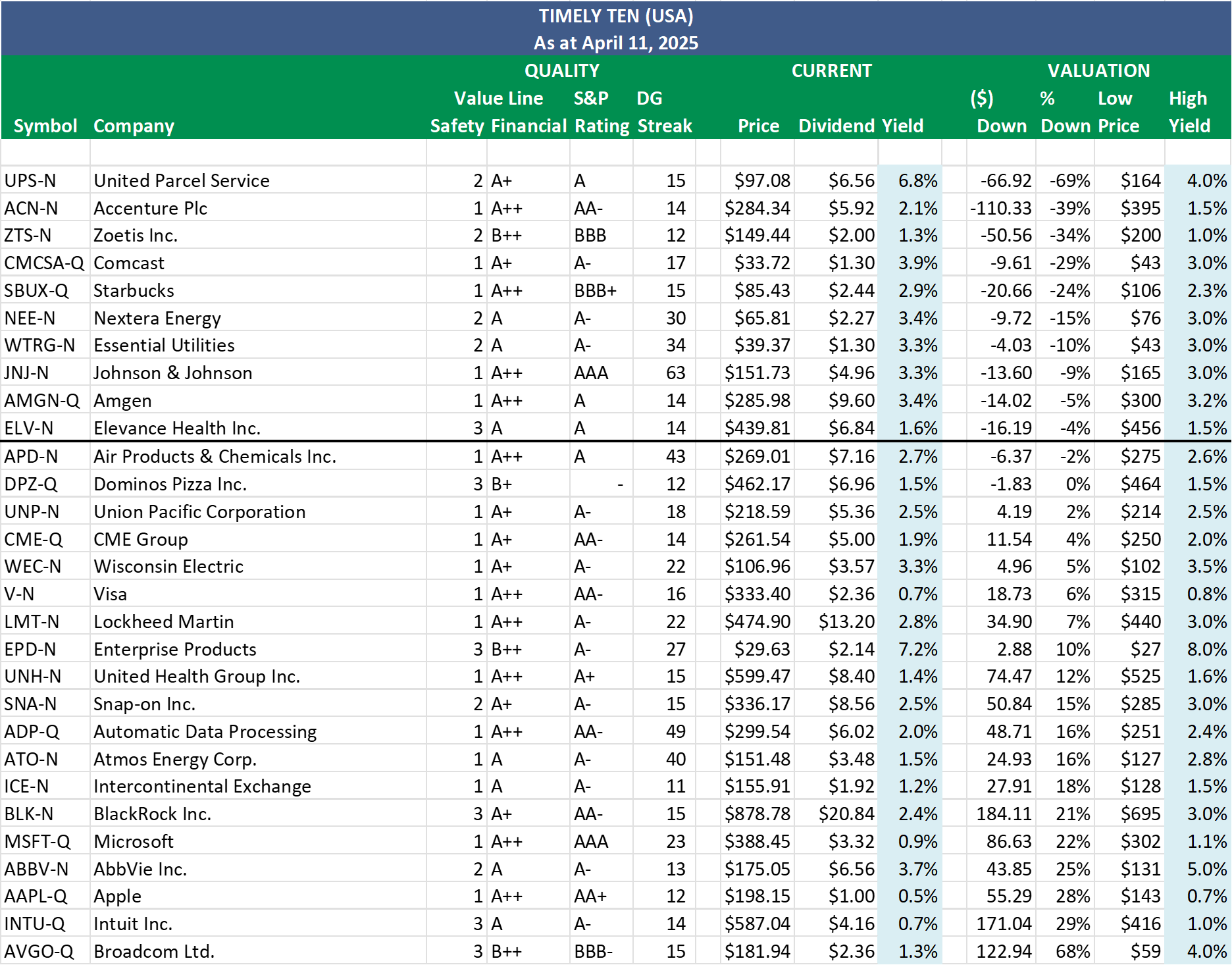
Below are the ten most undervalued dividend growth companies from our Canadian and U.S. watchlists, based on last Friday's closing prices.
Here's a recap on how we select our 'Timely Ten':
Step three in our process involves monitoring our quality dividend growers regularly, which can become quite challenging depending on the number of companies we track. Fortunately, we rely on 'The List' instead of the vast array of stocks in the index, which streamlines our task. Nevertheless, we continually seek methods to enhance our efficiency. Through dividend yield theory, we've discovered an approach that has proven remarkably effective in aiding us with our efforts over the years.
Dividend yield theory is a simple and intuitive approach to valuing dividend growth stocks. It suggests that the dividend yield of quality dividend growth stocks tends to revert to the mean over time, assuming that the underlying business model remains stable. In practical terms, if a stock pays a dividend yield above its ten-year average annual yield, its price will likely increase to return the yield to its historical average. Knowing that price and yield go in opposite directions, this theory helps us find stocks poised for a favourable price correction.
We have pre-screened our candidates using the criteria we initially laid out in building our watchlists. This helps us considerably narrow the universe of investable stocks.
Dividend growth streak: 10 years or more.
Market cap: Minimum one billion dollars.
Diversification: Limit of five companies per sector, preferably two per industry.
Cyclicality: Exclude REITs and pure-play energy companies due to high cyclicality.
Next, we rank our Canadian and American watchlists based on how far each stock's price is below its fair value (Low Price), as determined by dividend yield theory. To find fair value, divide the current dividend (Dividend) by the stock's historical high yield (High Yield).
Since price and yield move in opposite directions, a lower price results in a higher yield, and vice versa. The ten companies above the thick black line have a current price (Price) below fair value (Low Price). Put simply, these stocks have a current dividend yield higher than their historically high yield. According to dividend yield theory, these companies are sensibly priced and have the highest probability of a price increase in the shorter term. These are our 'Timely Ten.'
Wrap Up
The top-ranked stocks on both versions of ‘The List’ remain largely unchanged from last month, with only two new names—Amgen (AMGN-Q) and Johnson & Johnson (JNJ-N)- joining the ‘Timely Ten (USA)’.
Given the recent market volatility, you might expect a wave of new opportunities to emerge. But this highlights a key distinction between dividend growth stocks and pure growth stocks: dividend growers tend to hold their value better during turbulent times. Their prices don’t swing as wildly, which is exactly why we like them. Stability, predictability, and rising income—even when the broader market gets shaky.
When making investment decisions, always prioritize a company's 'quality' over a 'sensible price’. For more details on our quality indicators, download our Free Guide to Finding Quality Dividend Growth Stocks here.
If you're a new investor looking to build positions in the 'Timely Ten,' now is the perfect time to start your research and act.
Join as a paying subscriber to gain full access to this post and exclusive, subscriber-only content. Plus, get real-time DGI alerts from our model signaling service whenever we make trades in our portfolios. We do the work; you stay in control. Subscribe today and take your dividend growth investing to the next level!
DGI Scorecard
The List (2025)
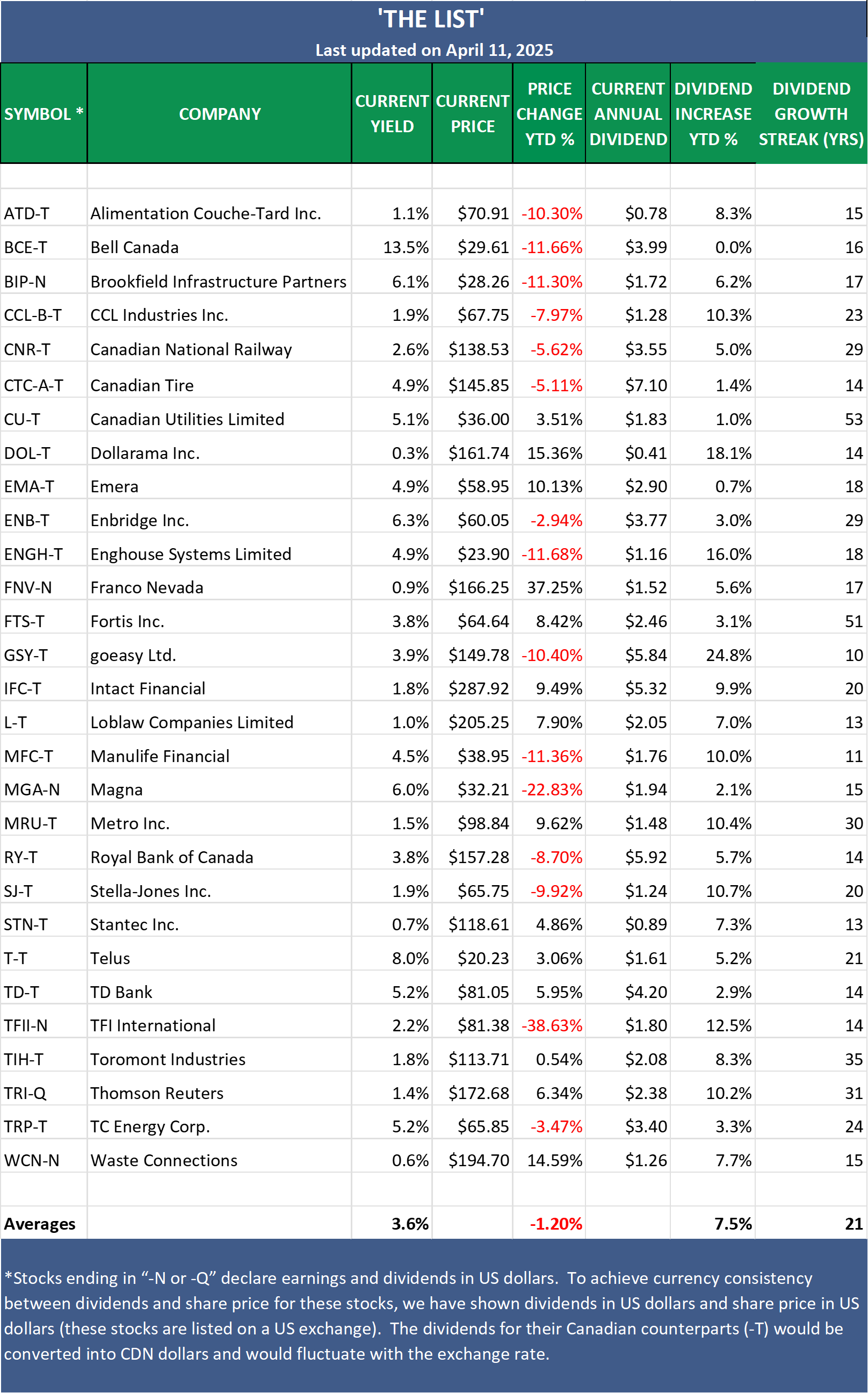
The Magic Pants 2025 list includes 29 Canadian dividend growth stocks. Here are the criteria to be considered a candidate on ‘The List’:
Dividend growth streak: 10 years or more.
Market cap: Minimum one billion dollars.
Diversification: Limit of five companies per sector, preferably two per industry.
Cyclicality: Exclude REITs and pure-play energy companies due to high cyclicality.
Based on these criteria, companies are added or removed from ‘The List’ annually on January 1. Prices and dividends are updated weekly.
‘The List’ is not a portfolio but a coaching tool that helps us think about ideas and risk manage our model portfolio. We own some but not all the companies on ‘The List’. In other words, we might want to buy these companies when valuation looks attractive.
Our newsletter provides readers with a comprehensive insight into the implementation and advantages of our dividend growth investing strategy. This evidence-based, unbiased approach empowers DIY investors to outperform both actively managed dividend funds and passively managed indexes and dividend ETFs over longer-term horizons.
Note: In the last week of every month, I will show the updated watchlist for our American dividend growers (‘The List-USA’). The watchlist will be shown after the Canadian watchlist below.
Performance of 'The List'
Last week, dividend growth was up, with an average return of +7.5% YTD (income).
The price of 'The List' was up from the previous week, with an average YTD return of -1.20% (capital).
Even though prices may fluctuate, the dependable growth in our income does not. Stay the course. You will be happy you did.
Last week's best performers on 'The List' were Franco Nevada (FNV-N), up +14.64%; goeasy Ltd. (GSY-T), up +5.62%; and Dollarama Inc. (DOL-T), up +5.01%.
Bell Canada (BCE-T) was the worst performer last week, down -8.55%.
No earnings reports last week, but the Q1 2025 calendar earnings season kicks off next week. We expect to gain valuable insight into how companies plan to navigate an increasingly uncertain market environment this year. The stock market isn’t “out of the woods” yet, as highlighted in our News section below. Stay tuned.
